In brief
- LIV Golf and 56 affiliates filed Chapter 11 on 8 September 2026 with $500M-$1B liabilities against $100M-$500M assets after Saudi PIF ended $5B funding, marking the costliest sports disruption's collapse.
- PIF's 2026-2030 strategy excluded international sports; fiscal pressure from oil cuts and Vision 2030 costs forced a commercial return test that LIV's offshore loss-making tour failed.
- LIV never secured broadcast rights fees, averaging 150,000-200,000 US viewers versus PGA Tour's 2-4 million; sponsors shunned it; team franchises held no assets and the league lost hundreds of millions annually.
- Unsecured player claims exceed $45M with Jon Rahm owed $7.5M; BC Partners' $300M "LIV 2.0" plan demanded contract terminations and equity swaps, but Rahm rejected it on 7-8 October 2026, risking mass departures.
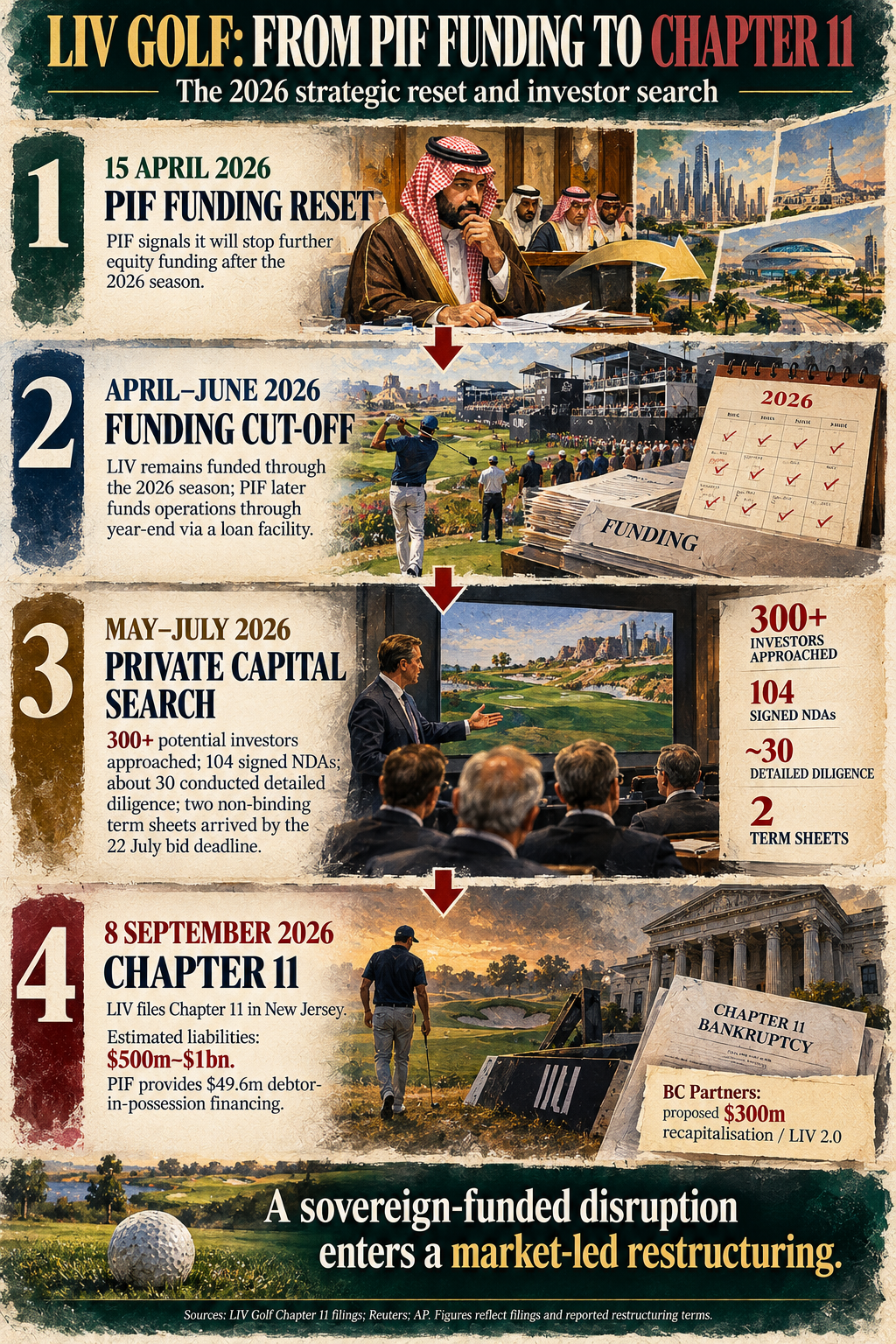
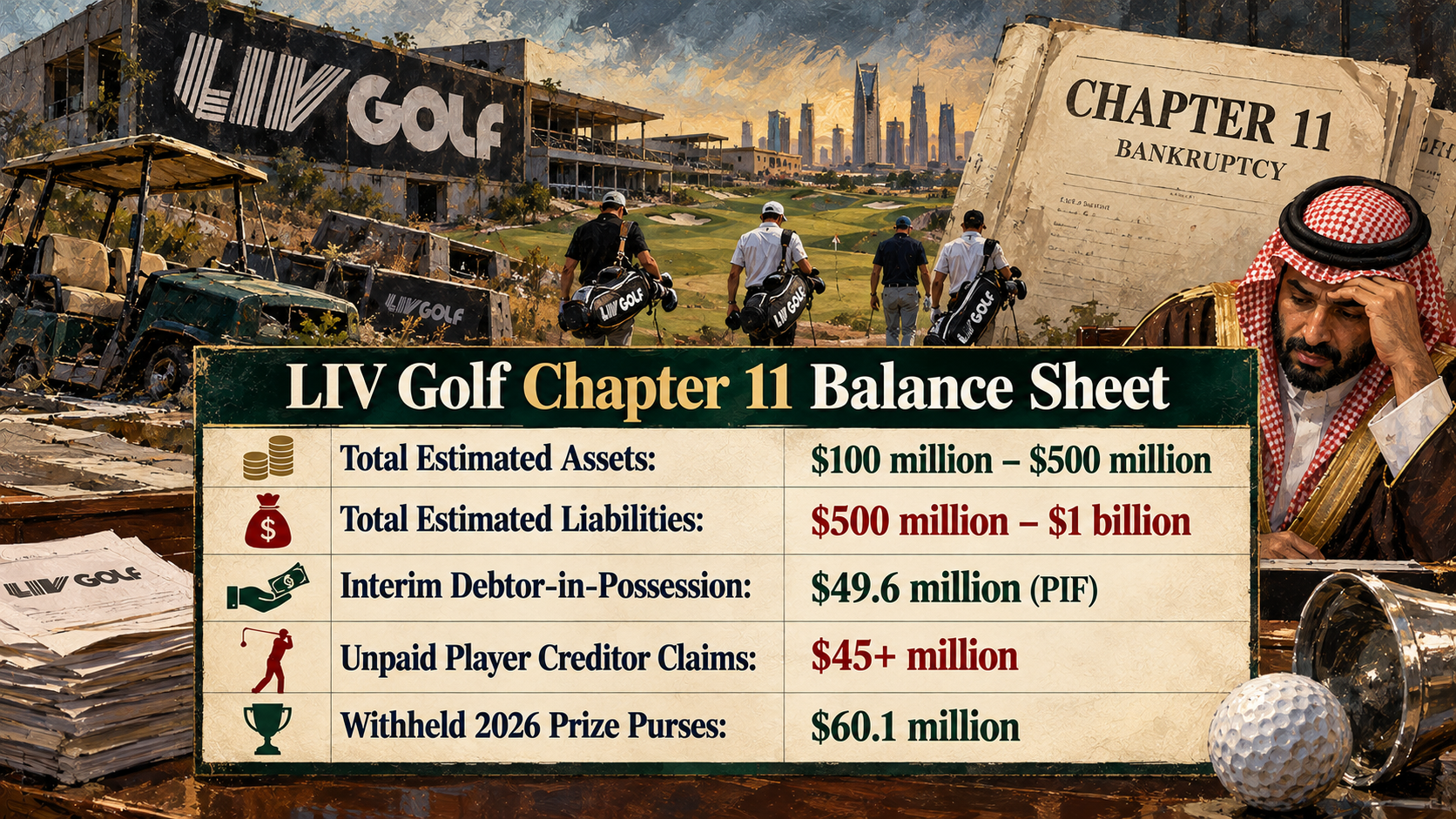
Four years after it fractured men's professional golf with hundreds of millions of dollars in sovereign guarantees, LIV Golf has collapsed into insolvency. On 8 September 2026, LIV Golf New Jersey LLC alongside 56 affiliated operating and team entities filed voluntary petitions for Chapter 11 bankruptcy protection in the United States Bankruptcy Court for the District of New Jersey.
The filings revealed estimated liabilities of between $500 million and $1 billion against assets valued at just $100 million to $500 million. To prevent an immediate mid-season liquidation, Saudi Arabia's Public Investment Fund (PIF)—the sovereign wealth vehicle that created, owned, and bankrolled the circuit—agreed to advance a modest $49.6 million in debtor-in-possession (DIP) financing.
The court appearance marked the end of the most expensive disruption in modern sports history. Between March 2022 and mid-2026, the PIF deployed more than $5 billion into LIV Golf. Yet when the league attempted to secure replacement private capital, its business model failed the scrutiny of the open market.
Understanding why LIV Golf failed requires examining two distinct failures: first, the complete commercial collapse of its operational business model; and second, a fundamental macroeconomic and strategic pivot inside Saudi Arabia that transformed the kingdom's sovereign investment priorities.
1. Why Saudi Arabia Stopped Backing LIV Golf
The popular narrative surrounding LIV Golf was that Riyadh possessed an infinite pool of capital and was indifferent to commercial losses. That assumption proved fatal to the league's planning.
The 2026–2030 Strategic Reprioritisation
On 15 April 2026, the PIF’s board of directors, chaired by Crown Prince Mohammed bin Salman, formally ratified the fund’s strategic roadmap for the 2026–2030 cycle. The document established six core domestic ecosystems for capital allocation:
Tourism, travel, and entertainment;
Urban development and liveability;
Advanced manufacturing and innovation;
Industrials and logistics;
Clean energy, water, and renewables infrastructure; and
Giga-projects, led by NEOM.
International standalone professional sports properties were absent from the list. Two weeks later, on 30 April 2026, the PIF issued a formal public statement confirming that funding for LIV Golf would terminate following the conclusion of the 2026 season. The fund stated bluntly that "the substantial investment required by LIV Golf over a longer term is no longer consistent with the current phase of PIF's investment strategy."
Fiscal Pressure and Domestic "Return Tests"
The decision was driven by financial realities within the kingdom. A combination of prolonged oil production cuts and lower global crude prices widened Saudi Arabia's state fiscal deficit throughout 2025 and 2026.
At the same time, the capital expenditure requirements for domestic Vision 2030 commitments escalated dramatically. With Riyadh preparing to host the 2030 World Expo and the kingdom confirmed as the host for the 2034 FIFA World Cup, capital demands shifted towards domestic stadiums, transport grids, and urban development. Several speculative giga-project timelines, including phases of NEOM’s The Line, were recalibrated.
In response, Saudi finance authorities subjected all PIF investments to a rigorous commercial "return test." While state funds continue to sponsor domestic events that build local infrastructure or tourism (such as the Saudi Pro League, tennis tournaments, and esports), underwriting an offshore, loss-making golf tour in the United States and Europe that generated no tangible domestic economic multiplier could no longer be justified to international debt markets.
2. What Went Wrong Inside LIV Golf's Business Model
LIV Golf was launched on the premise that traditional sports broadcasting and tournament models could be disrupted through guaranteed player contracts, team-based franchise equity, and a compressed 54-hole shotgun format. In practice, the business mechanics never functioned.
The Broadcasting Dead End
In elite sports, commercial solvency is anchored by television broadcast rights fees. The PGA Tour generates roughly $700 million annually from domestic US networks (CBS, NBC/Golf Channel) and overseas partners.
LIV Golf never commanded a meaningful broadcast rights fee:
The CW Network (2023–2024): LIV paid production expenses and operated on a secondary revenue-share model with low advertising yield.
Fox Sports and TNT Sports (2025–2026): While distribution expanded, network arrangements remained structured around time-buys and split sponsorship revenues rather than guaranteed multi-year rights windfalls.
Viewership Numbers: Live audience figures remained anemic. In April 2026, a final-round broadcast on US cable drew an estimated 49,000 viewers. Across the entire 2025 and 2026 seasons, LIV struggled to average more than 150,000 to 200,000 viewers on US terrestrial broadcasts, compared to PGA Tour Sunday audiences that regularly drew between 2 million and 4 million viewers for regular-season events.
Corporate Sponsorship Shunning
Major corporate sponsors provide the financial backbone of global golf. Blue-chip financial institutions, luxury automakers, and enterprise technology firms declined to sponsor LIV Golf tournaments or franchise teams.
The reluctance stemmed from two persistent issues:
Brand and Reputational Concerns: Lingering controversies surrounding geopolitical issues, human rights, and high-profile public demonstrations by 9/11 survivor groups created brand safety concerns that corporate marketing boards refused to accept.
Sub-Scale Reach: Even brands willing to overlook political controversies found the cost-per-thousand (CPM) metrics unviable due to low broadcast viewership and modest on-course attendance outside of isolated markets such as Adelaide.
The Failure of the Team Equity Franchise Concept
LIV’s stated long-term enterprise valuation was predicated on selling its 12 four-man team franchises (such as the Crushers, 4Aces, and Legion XIII) to private equity groups and multinational conglomerates for hundreds of millions of dollars each.
The model collapsed because the teams possessed no underlying assets:
Teams did not own stadiums or real estate.
They had no independent regional broadcast rights.
They had no long-term contractual claim on players once individual multi-year contracts expired.
Crucially, the central league was absorbing hundreds of millions in operational losses each year, meaning team franchise equity represented a liability rather than a cash-flow-generating asset.
On 24 August 2026, two weeks prior to the Chapter 11 filing, LIV cancelled its internal team equity structures entirely as insolvency loomed.
3. The Failed Merger and the Strategic Sports Group Checkmate
When LIV Golf and the PGA Tour announced a shock "Framework Agreement" on 6 June 2023 alongside the DP World Tour, it appeared that the PIF would purchase an influential stake in a unified global golf entity, giving LIV an orderly commercial landing. Instead, the agreement unraveled.
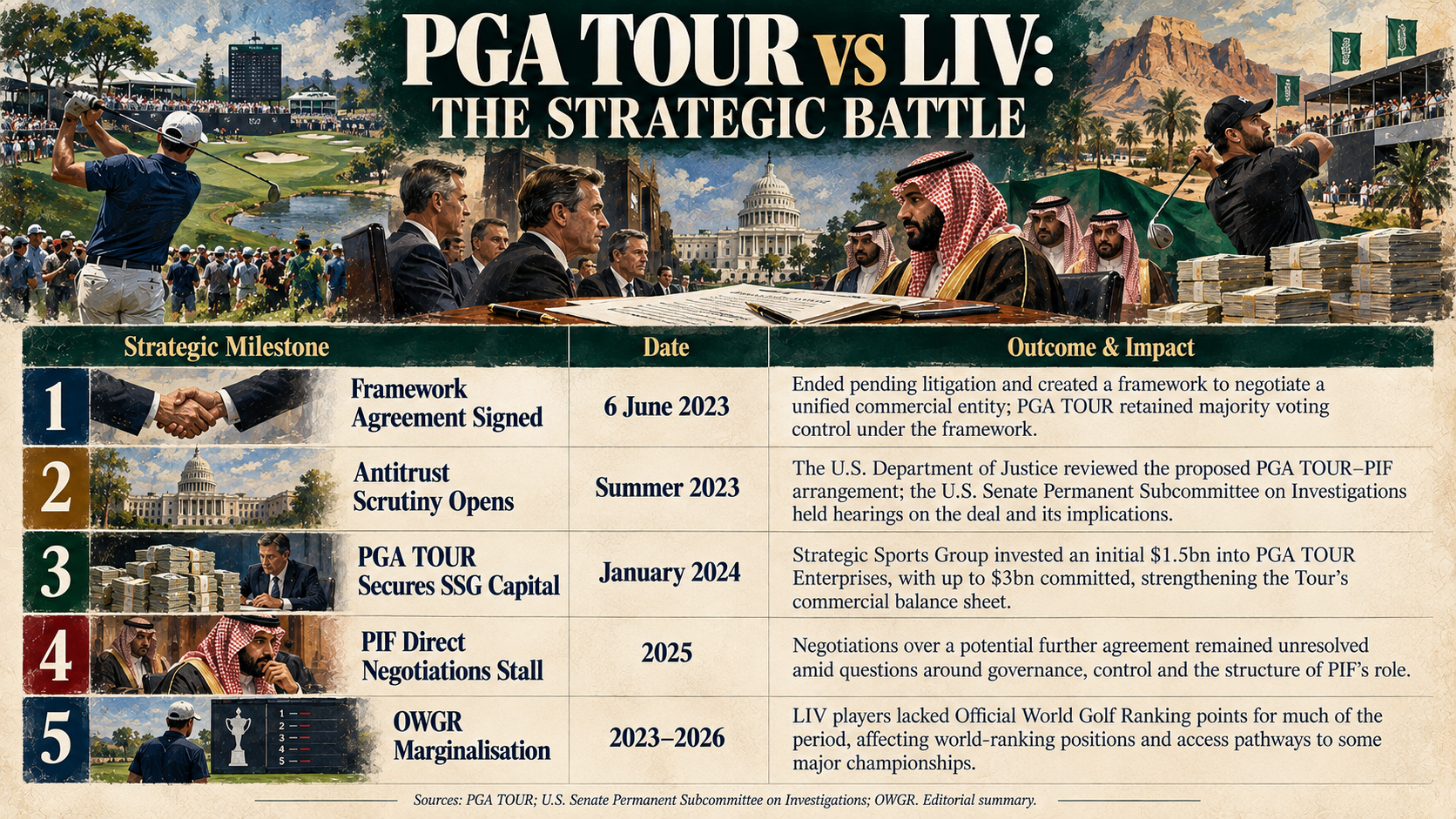
Once the PGA Tour secured private equity funding from American sports owners through Strategic Sports Group, it no longer faced a liquidity crisis. PGA Tour leadership could afford to walk away from governance demands insisted upon by Riyadh. Without unification, LIV remained an isolated rebel circuit that had to fund every dollar of its operations out of pocket.
4. The Chapter 11 Filing and the Battle Over "LIV 2.0"
When PIF announced its funding cut-off in April 2026, LIV Golf's management hired advisory firm AlixPartners to run a four-month emergency sale process. According to the sworn declaration of Chief Restructuring Officer David Orlofsky:
More than 300 prospective strategic, media, and institutional financial investors were contacted.
Only two non-binding proposals were submitted.
Both proposals required a court-supervised restructuring to wipe out existing contractual liabilities.
Unsecured Creditors: The Players
LIV filed for Chapter 11 on 8 September 2026 in the District of New Jersey. Its list of unsecured creditors revealed that the league’s single largest liability was its unpaid contractual obligations to its marquee golfers.
Overall, player claims exceeded $45 million in unpaid guaranteed bonuses and withheld prize purses ($60.1 million in 2026 prize money had been frozen or redirected during the liquidity crunch). Two-time major winner Jon Rahm topped the schedule of unsecured claims, owed an immediate $7.5 million in unpaid contractual sums, with Bryson DeChambeau also holding multi-million-dollar claims.
The Rejection of "LIV 2.0"
To exit bankruptcy, LIV presented a Restructuring Support Agreement backed by private credit firm BC Partners Credit, which offered up to $300 million in exit financing for a rebooted 2027 season dubbed "LIV 2.0".
However, BC Partners’ terms demanded radical austerity:
Terminating all existing guaranteed player contracts.
Introducing performance-only prize money, traditional 72-hole play, Monday qualifiers, and 36-hole cuts.
Offering golfers deeply subordinated, minority equity in the restructured holding company, with BC Partners retaining priority liquidation rights.
The restructuring strategy suffered an immediate blow in court. On 7–8 October 2026, John Beck, legal counsel representing Jon Rahm, told the US Bankruptcy Court in New Jersey that the Masters champion had reviewed the proposal and decided to walk away:
"Mr Rahm has independently reviewed the proposed terms of LIV 2.0 … and has determined that those terms are unacceptable as to him, and he will not be participating going forward in LIV 2.0."
Rahm’s refusal to accept equity in lieu of guaranteed contracts threatens to trigger a cascade of departures, as remaining stars assess whether to attempt a return to the PGA Tour and DP World Tour or compete under an unbacked, low-purse league structure.
5. What Happens Next: Golf’s Landscape After the Collapse
The bankruptcy of LIV Golf leaves professional men’s golf facing complex legal and institutional questions:
Player Contract Rejection and Re-entry: Under US bankruptcy law, debtors can formally reject executory contracts. With LIV unable to pay guaranteed sums, players are seeking court orders releasing them from restrictive non-compete covenants. This opens the door for negotiations with the PGA Tour and DP World Tour, though returning players face fines, suspensions, or requirements to surrender past prize earnings.
The Status of the PIF in Golf: Saudi Arabia has not exited golf entirely, but its posture has transformed. Instead of underwriting a disruptive standalone league, the PIF is expected to limit its presence to passive corporate sponsorships (such as its DP World Tour partnerships and Aramco-backed women's events) and sovereign event hosting in the kingdom.
The Lesson for Discretionary Sports Capital: LIV Golf demonstrated the operational limits of sovereign disruption in sports entertainment. Without organic broadcast viewership, engaged brand partners, and structural integration with established governing bodies, even $5 billion in sovereign capital could not manufacture an enduring commercial enterprise.