In brief
- Indian equities crashed on 8 October 2026 with Nifty hitting 52-week low of 22,181 and Sensex falling over 1,045 points erasing ₹10 lakh crore investor wealth after RBI surprise rate hike
- RBI raised repo rate 25 basis points to 5.50% on 7 October first hike in nearly four years and shifted stance to calibrated tightening while raising FY27 inflation forecast to 5.1%
- Brent crude above $102 per barrel from West Asia conflict and US Treasury yields near 5.3% with dollar index at 102 triggered foreign outflows of ₹43,395 crore over six sessions
- Rate-sensitive sectors led declines with realty banking auto and Reliance Industries falling sharply while Nifty broke below 200-day moving average and India VIX jumped 10.37% to 15.33
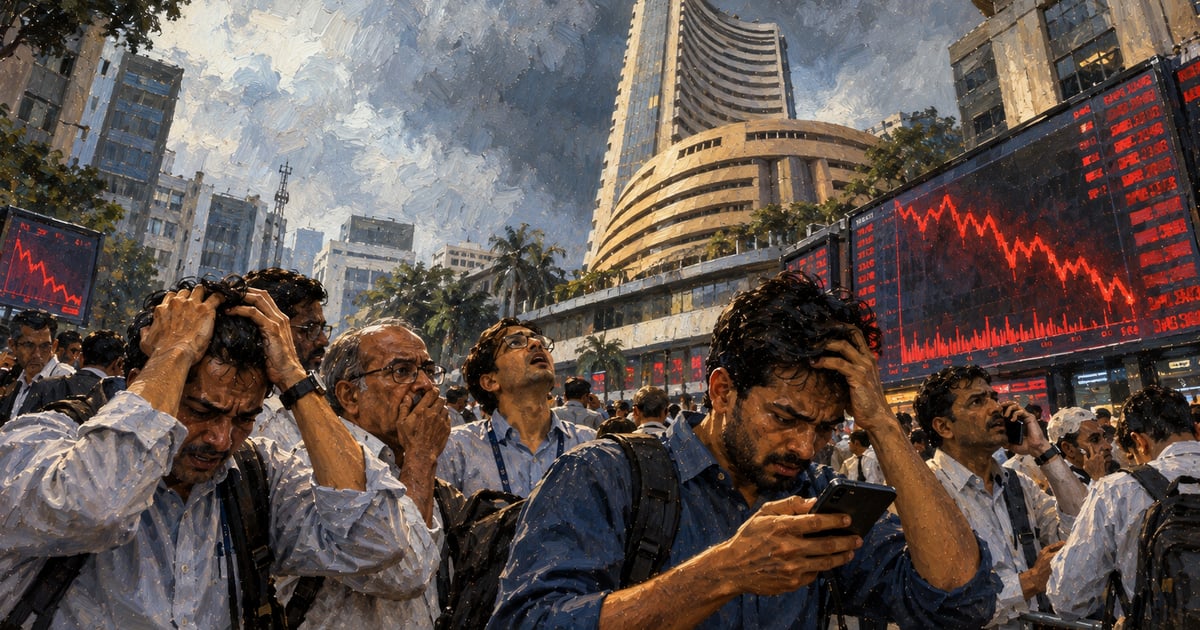
The benchmark NSE Nifty 50 tumbled into technical distress on Thursday, 8 October 2026, sinking as much as 371 points intraday to touch a fresh 52-week low of 22,181.00. The broader BSE Sensex shed over 1,045 points to settle near 71,937, eroding approximately ₹10 lakh crore ($120 billion) of investor wealth across Indian equities in a single session.
While Dalal Street had already spent several sessions digesting geopolitical tensions and elevated commodity prices, the primary catalyst that tipped the market from an orderly pullback into a steep sell-off was monetary policy. Just 24 hours earlier, on 7 October, the Reserve Bank of India delivered its first benchmark interest rate increase in nearly four years, catching an equity market conditioned on stable or declining borrowing costs off balance.
The Domestic Shock: RBI's Surprise Rate Hike and Stance Shift
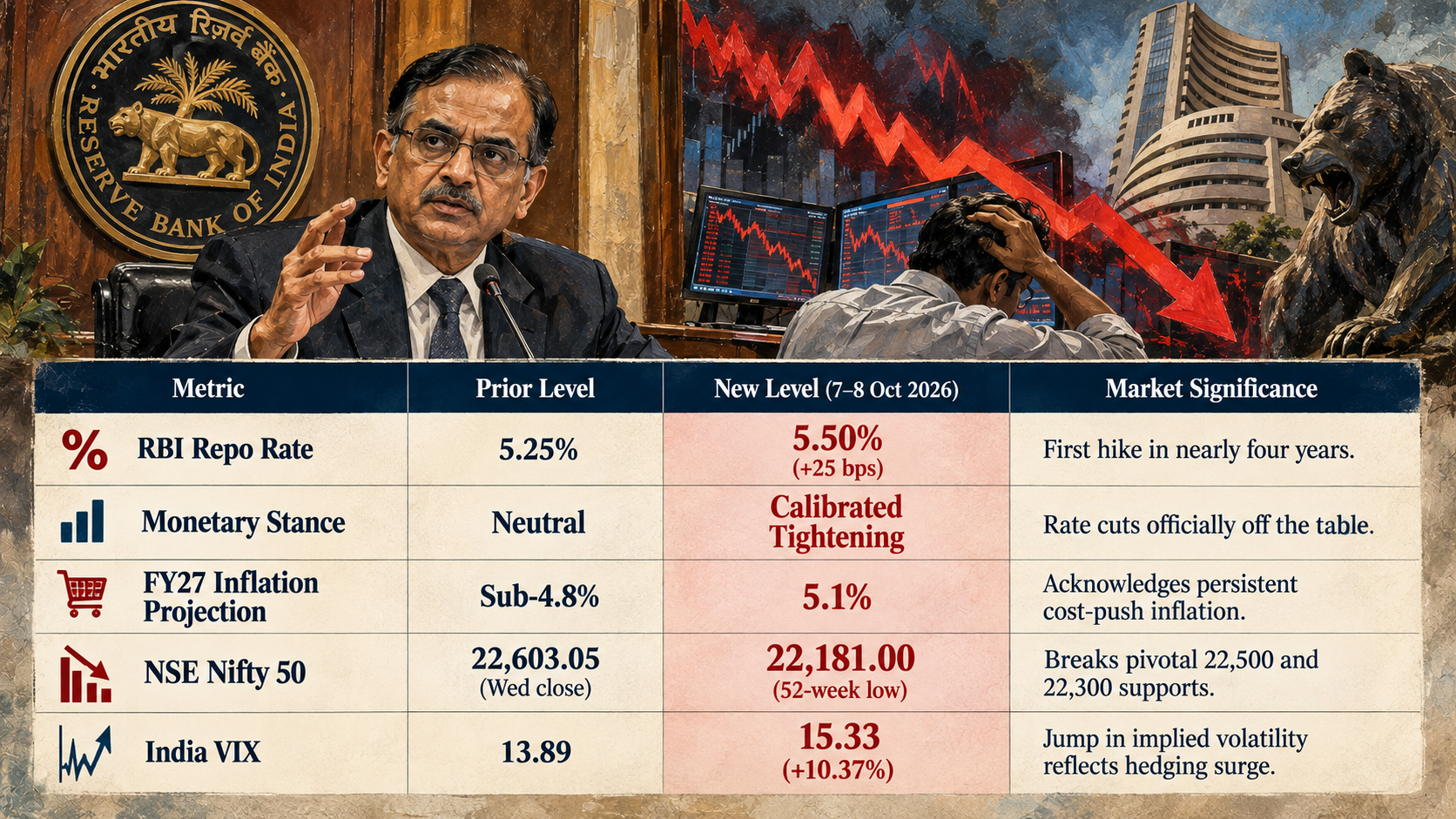
On Wednesday, 7 October 2026, the RBI’s Monetary Policy Committee, chaired by Governor Sanjay Malhotra, concluded its 63rd bi-monthly policy review. In a unanimous vote, the MPC raised the policy repo rate by 25 basis points from 5.25% to 5.50%.
The repo rate had remained at 5.25% since December 2025, when the central bank concluded an earlier easing phase. What unsettled financial institutions was not merely the quarter-point increase, but the accompanying shift in monetary stance from "neutral" to "calibrated tightening".
Announcing the decision, Governor Malhotra stated that future policy actions could only take the form of another rate hike or an extended pause, removing any prospect of near-term rate cuts. The central bank also lifted its headline CPI inflation projection for FY27 to 5.1%, citing stubborn imported price pressures.
For equity markets, an unexpected shift to calibrated tightening alters the fundamental math of valuation. Discount rates applied to long-duration corporate cash flows rose immediately, penalising high-multiple growth equities and rate-sensitive cyclicals.
Why the RBI Acted: Crude Oil at $102 and the West Asia Flare-Up
The central bank’s decision to tighten policy was not made in isolation. It responded directly to an external commodity shock.
Escalating military conflict in West Asia and fears of broader regional confrontation involving Iran and the United States pushed Brent crude oil prices past $102 per barrel. Because India imports over 85% of its crude oil requirements, sustained triple-digit oil prices transmit directly into the domestic economy through higher transport logistics costs, raw material expenses for petrochemical and paint manufacturers, and pressure on the current account balance.
Higher oil also threatens fiscal projections through fuel excise revenues and fertiliser subsidies, leaving monetary authorities with little leeway to keep interest rates low while import prices escalate.
Global Yields and Foreign Institutional Investor Capitulation
Domestic tightening coincided with an acute liquidity squeeze in global sovereign debt markets. The yield on the benchmark 10-year US Treasury bond climbed near 5.3%, buoyed by resilient US labour data and hawkish Federal Reserve minutes that rekindled expectations of higher-for-longer American interest rates.
Concurrently, the US Dollar Index (DXY) advanced to 102, trading near an 18-month high. This strength placed sustained pressure on emerging-market currencies. The Indian Rupee fell to spot levels of 96.76–96.81 per US dollar, lingering within striking distance of its all-time low of 96.96 recorded in May 2026.
This environment accelerated foreign capital outflows:
Foreign Institutional Investors offloaded equities worth ₹43,395 crore ($5.2 billion) across six consecutive trading sessions heading into 8 October.
On Wednesday, 7 October alone, net foreign institutional sales stood at ₹6,121.37 crore ($735 million).
Although Domestic Institutional Investors provided counterbalancing bids of ₹4,597 crore on Wednesday, domestic liquidity proved insufficient to absorb the dual wave of foreign portfolio liquidation and derivatives-expiry selling on Thursday.
Sectoral Impact: The Sectors That Led Dalal Street Down
The sell-off was broad-based, but rate-sensitive cyclicals and oil-exposed corporations suffered the steepest cuts:
Real Estate and Housing Finance: The Nifty Realty index was among the worst performers. Expectations of an immediate upward repricing in marginal cost of funds-based lending rates (MCLR) and external benchmark lending rates (EBLR) raised concerns over housing affordability and pre-sales momentum.
Banking and Financial Services: The Bank Nifty slid towards 54,730. While rising interest rates typically support net interest margins in the initial phase of a tightening cycle, investors reacted to risks of rising credit costs, bond treasury portfolio mark-to-market losses, and slowing retail loan growth.
Automotive: Auto manufacturers declined under the combined burden of higher consumer financing rates and elevated input costs driven by energy prices.
Energy and Aviation Heavyweights: Reliance Industries retreated over 2%, weighing heavily on the Nifty 50 given its large index weighting, while aviation carriers such as InterGlobe Aviation (IndiGo) dropped sharply as jet fuel prices tracked global crude higher.
Technical Breakdown: Where Dalal Street Stands Now
From a technical perspective, the Nifty 50 had spent several weeks attempting to hold above its key 22,800 pivot. The breakdown below 22,500 on Wednesday afternoon breached the 200-day moving average, triggering automated stop-loss orders across institutional trading desks.
When the index opened weak on Thursday, support at 22,300 failed within the first two hours of trade, directly exposing the previous 52-week low of 22,182.55. The intraday print of 22,181 represented an exact test of Dalal Street's annual floor. Market volatility, tracked by the India VIX, jumped 10.37% to 15.33, signalling elevated hedging activity among institutional participants.
Market participants will closely monitor whether the 22,180–22,200 support zone holds over upcoming sessions. A sustained recovery will require a stabilisation in crude oil prices, an easing of US Treasury yields, and a slowdown in relentless foreign portfolio liquidation. Until then, Dalal Street operates in an environment where the safety net of monetary easing has been decisively withdrawn.