In brief
- Saudi Arabia’s annual defence expenditure of $83.2 billion (approx. ₹6.9 lakh crore) could not secure victory in its eight‑year Yemen intervention, prompting a diplomatic shift in 2023.
- A Patriot interceptor costs $1‑4 million while a Houthi loitering munition costs $10,000‑$25,000; firing two interceptors per track against a five‑drone swarm uses $20‑30 million to destroy less than $100,000 of enemy hardware.
- The Saudi armed forces are split into rival ministries, rely on US/UK contractors for maintenance, and operate in mountainous terrain where Houthis excel, while coalition ground proxies remain fragmented and often turn on each other.
- Vision 2030’s need for stability was highlighted by the 2019 Abqaiq‑Khurais attack that cut 5.7 million barrels per day; Saudi Arabia then signed the Beijing Agreement in March 2023 and declined to join Operation Prosperity Guardian in 2023‑24.
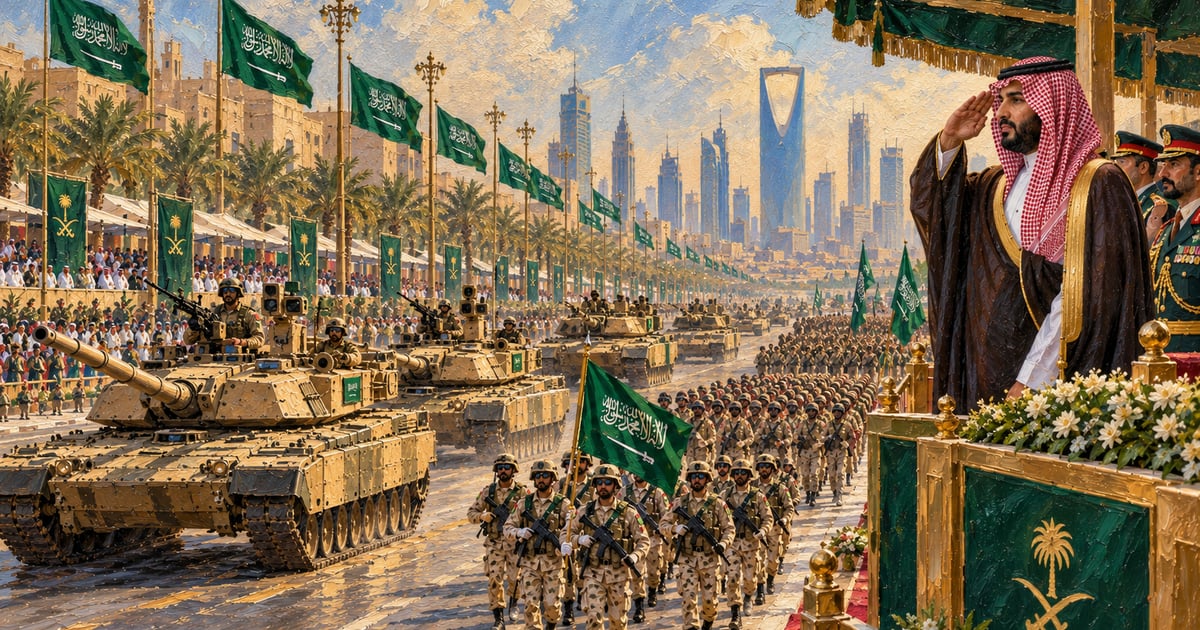
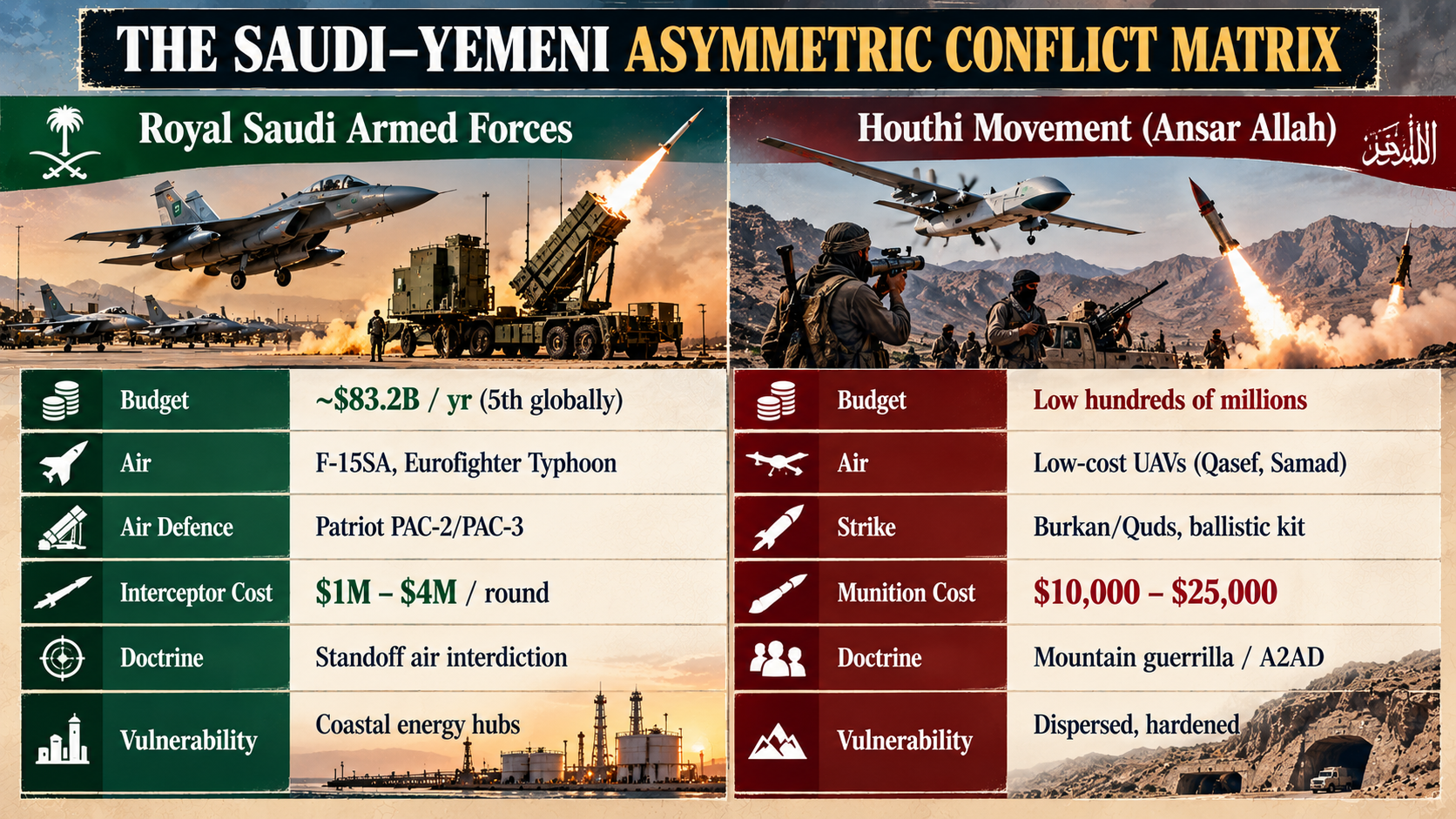
Saudi Arabia allocates more capital to its military apparatus than almost any sovereign state on earth. With an estimated annual defence expenditure of $83.2 billion (approx. ₹6.9 lakh crore)—trailing only the United States, China, Russia, and India in the SIPRI Military Expenditure Database—the Kingdom boasts an arsenal of Boeing F-15SA Strike Eagles, Eurofighter Typhoons, and Raytheon MIM-104 Patriot missile batteries.
Yet when Riyadh intervened in Yemen in March 2015 at the head of a ten-country coalition, Operation Decisive Storm was envisioned as a brisk, weeks-long aerial campaign to restore the internationally recognised government of President Abed Rabbo Mansour Hadi. Instead, the intervention developed into an eight-year war of attrition.
By the time a United Nations-brokered truce took hold in April 2022, Houthi forces (Ansar Allah) had not only retained control of Sanaa and the northern highlands, but were routinely launching ballistic missiles and loitering munitions into Riyadh, Jazan, and the facilities of state oil producer Saudi Aramco. In April 2023, Saudi Ambassador Mohammed al-Jaber travelled to Sanaa to negotiate directly with Houthi leaders, formalising a shift from military confrontation to diplomatic accommodation.
The explanation for this outcome lies in the difference between military expenditure and combat effectiveness. The Saudi armed forces were structured, equipped, and politically engineered for internal regime preservation and conventional deterrence against regional states, not for prosecuting counter-insurgency campaigns across rugged, foreign mountain terrain against a highly adaptable asymmetric adversary.
The Cost-Exchange Curve: How Cheap Drones Exhausted Multi-Million-Dollar Missiles
The most visible operational vulnerability exposed during the conflict was the asymmetric arithmetic of air defence. As documented in a comprehensive empirical survey by the Center for Strategic and International Studies (CSIS), Houthi forces executed over 4,100 cross-border and regional stand-off attacks between 2016 and late 2021.
While the Royal Saudi Air Defense Forces (RSADF) demonstrated high interception rates—regularly shooting down roughly 85% to 90% of incoming targets—the economic and logistical exchange rate proved ruinous.
A single Patriot Advanced Capability-2 (PAC-2) or PAC-3 interceptor costs between $1 million and $4 million (approx. ₹8.3 crore to ₹33 crore). Conversely, Houthi loitering munitions, such as the delta-wing Qasef-2K and the Samad-3 (derived from Iranian Ababil designs), cost an estimated $10,000 to $25,000 each (approx. ₹8.3 lakh to ₹20.8 lakh), as detailed by the Observer Research Foundation.
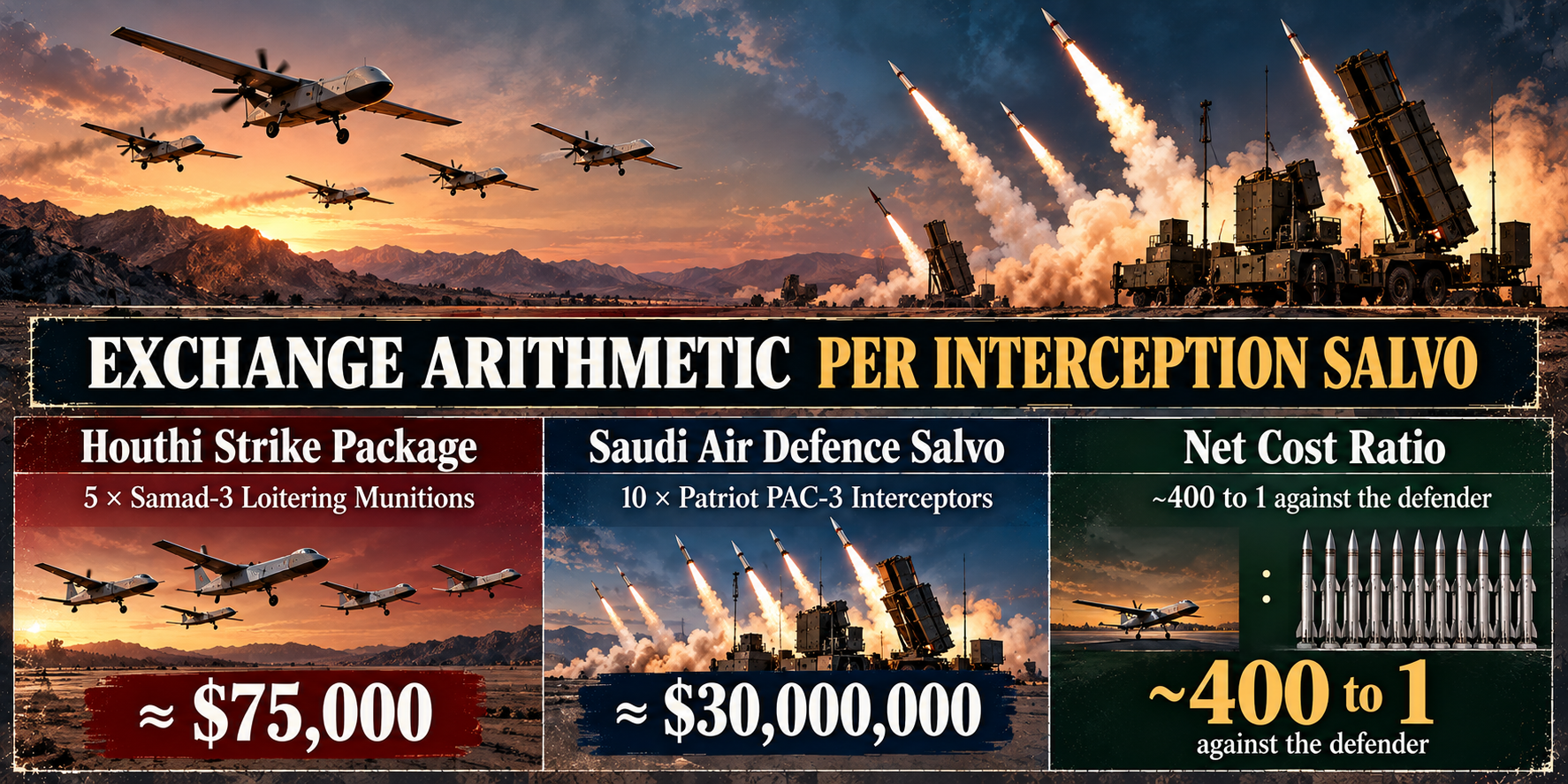
Deploying two interceptor missiles per incoming track meant that an interception volley against a five-drone swarm consumed upwards of $20 million to $30 million in munitions to destroy hardware worth less than $100,000.
Furthermore, global production lines for Patriot interceptors could not keep pace with expenditure rates. Riyadh repeatedly faced supply pinches, forcing emergency appeals to Washington and neighbouring Gulf Cooperation Council partners for interceptor replenishment. The Houthis transformed Saudi Arabia’s air defence network into a strategic financial sinkhole, making defense mathematically unsustainable over a multi-year horizon.
Coup-Proofing and Structural Fragmentation
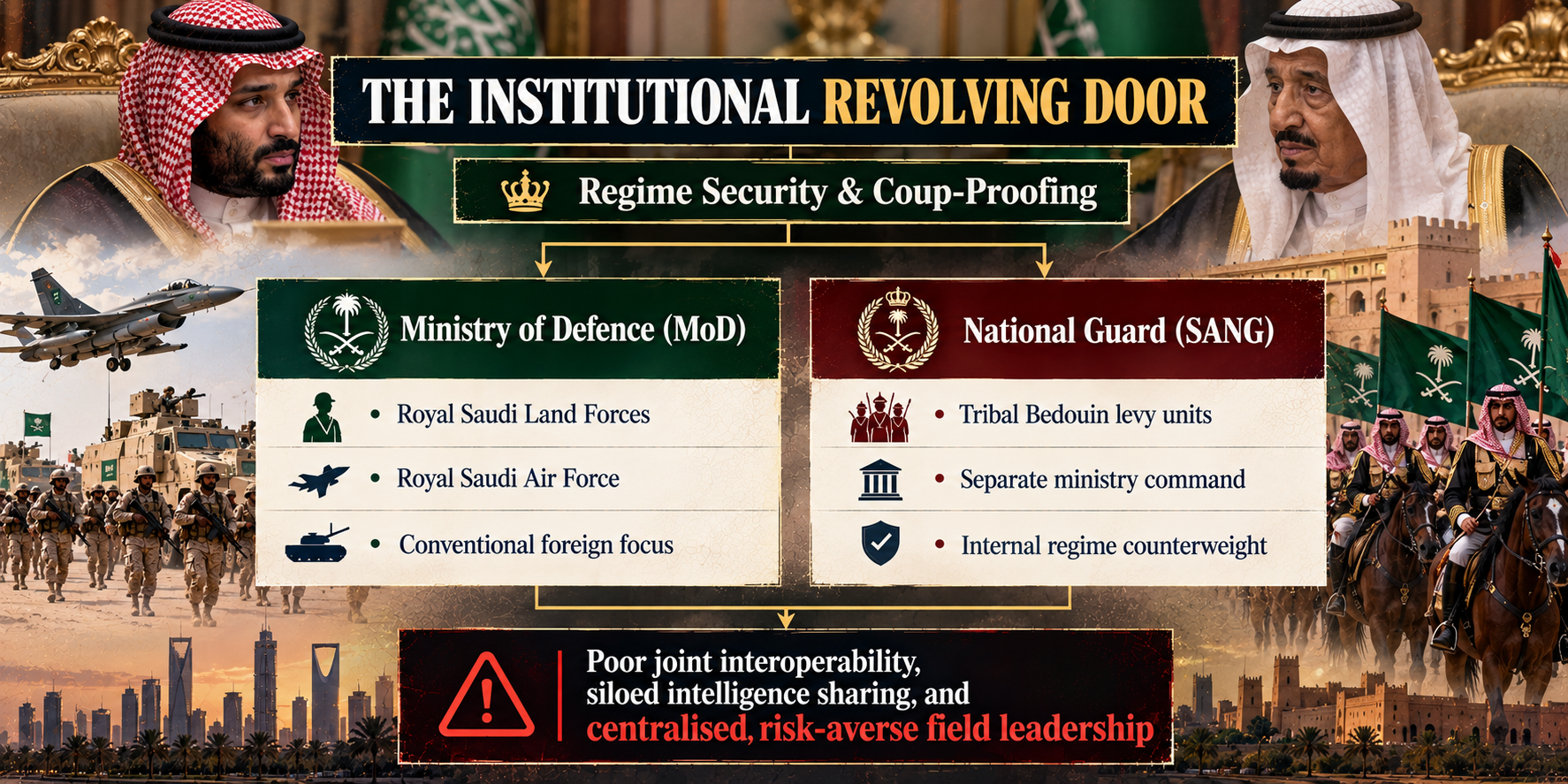
Military spending figures obscure the internal design of the Saudi military establishment. Historically, monarchies in the region prioritised insulating the ruling house from internal military coups over optimising expeditionary combat performance, a phenomenon documented in comparative political studies on Coup-Proofing in MENA.
To prevent the concentration of coercive power in a single command, the Saudi armed forces were divided into rival institutional pillars:
The Ministry of Defence: Controls the regular armed branches, including the Royal Saudi Land Forces (RSLF), Royal Saudi Air Force (RSAF), and Royal Saudi Navy.
The Saudi Arabian National Guard (SANG): An autonomous ground force recruited predominantly from tribes historically loyal to the Al Saud dynasty, answerable to a distinct ministry and historically loyal to the late King Abdullah's branch of the family.
The Ministry of Interior and Royal Guard: Heavily armed internal security and paramilitary formations operating under distinct operational channels.
This division intentionally hindered cross-branch operational integration. Joint planning, shared communications infrastructure, and dynamic combined-arms coordination—where armoured units, infantry, artillery, and close air support maneuver synchronously—were weak.
When Houthi raiding units crossed the border into Saudi Arabia's southwestern provinces of Jazan, Najran, and Asir, Saudi outpost garrisons frequently fought in isolation. Heavy M1A2 Abrams main battle tanks and Bradley fighting vehicles were deployed in static defensive positions along mountain roads without adequate dismounted infantry screens, allowing small Houthi teams armed with Konkurs and Kornet anti-tank guided missiles (ATGMs) to ambush and destroy them.
Total Dependence on Foreign Contractors and Standoff Air Doctrine
The Royal Saudi Air Force operates sophisticated strike platforms, but the logistical tissue that keeps those platforms airworthy resides abroad.
As noted by military analyst Bruce Riedel in an analysis for the Brookings Institution, the Saudi military machine remains heavily reliant on foreign technical support. Thousands of civilian contractors—principally from the United States and the United Kingdom—handle scheduled maintenance, radar calibrations, avionics overhauls, engine repairs, and weapons loading for the Kingdom's F-15 and Typhoon fleets. Had American and British contractors been withdrawn, the operational availability of the Saudi strike fleet would have degraded within weeks.
This reliance, coupled with political sensitivity regarding domestic military casualties, shaped an operational doctrine reliant almost exclusively on high-altitude air interdiction.
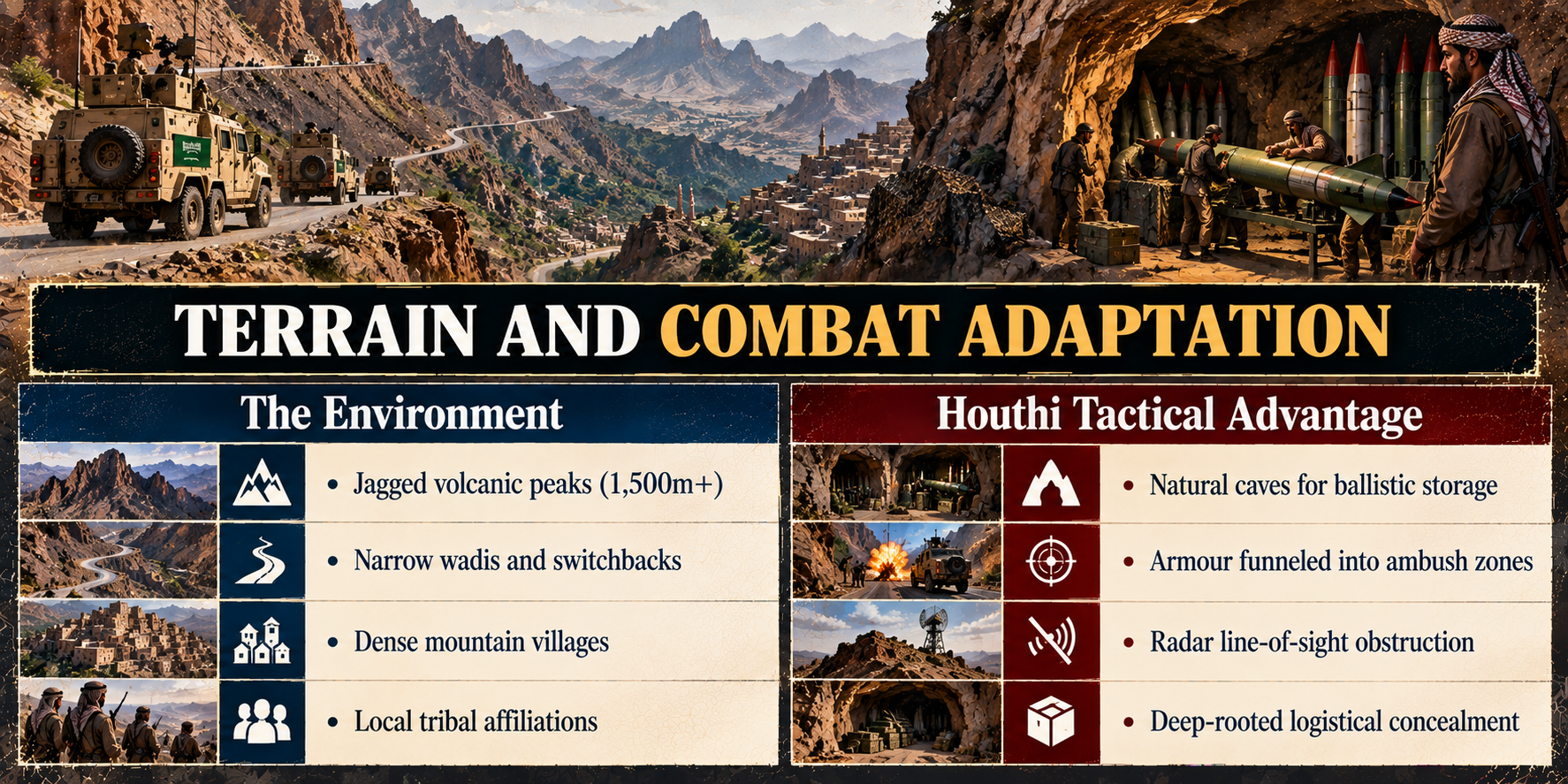
However, air campaigns alone cannot seize or hold territory, particularly against an adversary that does not rely on concentrated troop formations, fixed bases, or industrial logistics nodes. The Houthis dispersed their command centers into urban districts, stored ordnance in natural cave networks, and operated mobile missile launchers that emerged from subterranean shelters, fired, and vanished before orbiting combat air patrols could prosecute the kill chain.
When coalition strikes caused civilian casualties—such as the strikes on funeral halls, marketplaces, and schools—international political pressure mounted on Washington and London, prompting temporary bans on precision-guided munition transfers and intelligence restrictions that further constrained Riyadh's operational latitude.
The Terrain of Saada and Decades of Insurgent Conditioning
The physical and human geography of northern Yemen heavily favours defensive asymmetric warfare. The Houthi heartland of Saada and the rugged highlands surrounding Sanaa consist of serrated mountain ranges, steep canyons, and high plateaus varying between 1,500 and 3,000 metres above sea level.
Mechanised armour cannot navigate these narrow defiles without extreme vulnerability to mines and shoulder-launched weapons. Conversely, light infantry fighters familiar with local topography can move across terrain on foot, relying on familial and tribal logistics networks.
The Houthis were not raw recruits in 2015. Between 2004 and 2010, the group fought six successive conventional conflicts (the Saada Wars) against the Yemeni Armed Forces led by then-President Ali Abdullah Saleh, who was backed covertly by Saudi cross-border air and artillery strikes.
During these six campaigns, the Houthis developed institutional resilience against modern firepower, mastered tunnel warfare, perfected camouflage against aerial surveillance, and learned how to exploit gaps between conventional army garrisons. When the 2015 coalition campaign began, the Houthis allied with their former foe, Saleh, absorbing elite elements of the Yemeni Republican Guard along with their intact ballistic missile arsenals, military communications networks, and heavy weapons depots.
The Proxy Dilemma: Coalition Infighting on the Ground
Unwilling to risk thousands of domestic conscripts in a grinding ground invasion of the northern mountains, Saudi Arabia attempted to wage the land war by proxy.
Riyadh financed, equipped, and relied upon a disparate patchwork of local and foreign ground forces:
Yemeni regular army remnants loyal to President Hadi;
Sunnis and Muslim Brotherhood-aligned tribal fighters affiliated with the Islah Party;
Foreign mercenary ground contingents, including thousands of Sudanese Rapid Support Forces (RSF) troops deployed along the border;
Southern Yemeni secessionist militias.
These factions shared little beyond a transactional relationship with Riyadh's treasury. Most damagingly, the coalition fractured between its two principal foreign backers: Saudi Arabia and the United Arab Emirates (UAE).
While Riyadh prioritised protecting its southern border and restoring a friendly central government in Sanaa, Abu Dhabi prioritised maritime choke points along the Gulf of Aden, the Red Sea, and the Bab el-Mandeb strait. The UAE heavily trained and funded the Southern Transitional Council (STC) and the Giants Brigades (Al-Amaliqa), groups whose core political objective was the restoration of an independent South Yemen, not the liberation of northern Houthi-held provinces.
By 2019, when the UAE unilaterally withdrew the bulk of its conventional forces from Yemen, the anti-Houthi coalition routinely turned its weapons inward, with the STC clashing violently with Saudi-backed government forces for control of Aden and Abyan. The Houthis faced an enemy divided against itself.
Strategic Vulnerability: Vision 2030 vs The War of Attrition
The turning point was economic and structural rather than purely military. Crown Prince Mohammed bin Salman’s overarching domestic programme, Vision 2030, requires hundreds of billions of dollars in foreign direct investment, the rapid growth of international tourism, and the construction of gigaprojects like NEOM and the Red Sea Project along the western coastline.
Vision 2030 cannot succeed in an environment where incoming drones trigger air raid sirens in regional capitals, foreign embassies issue travel advisories, and commercial flights into Jeddah and Riyadh are diverted due to incoming ballistic missile warnings.
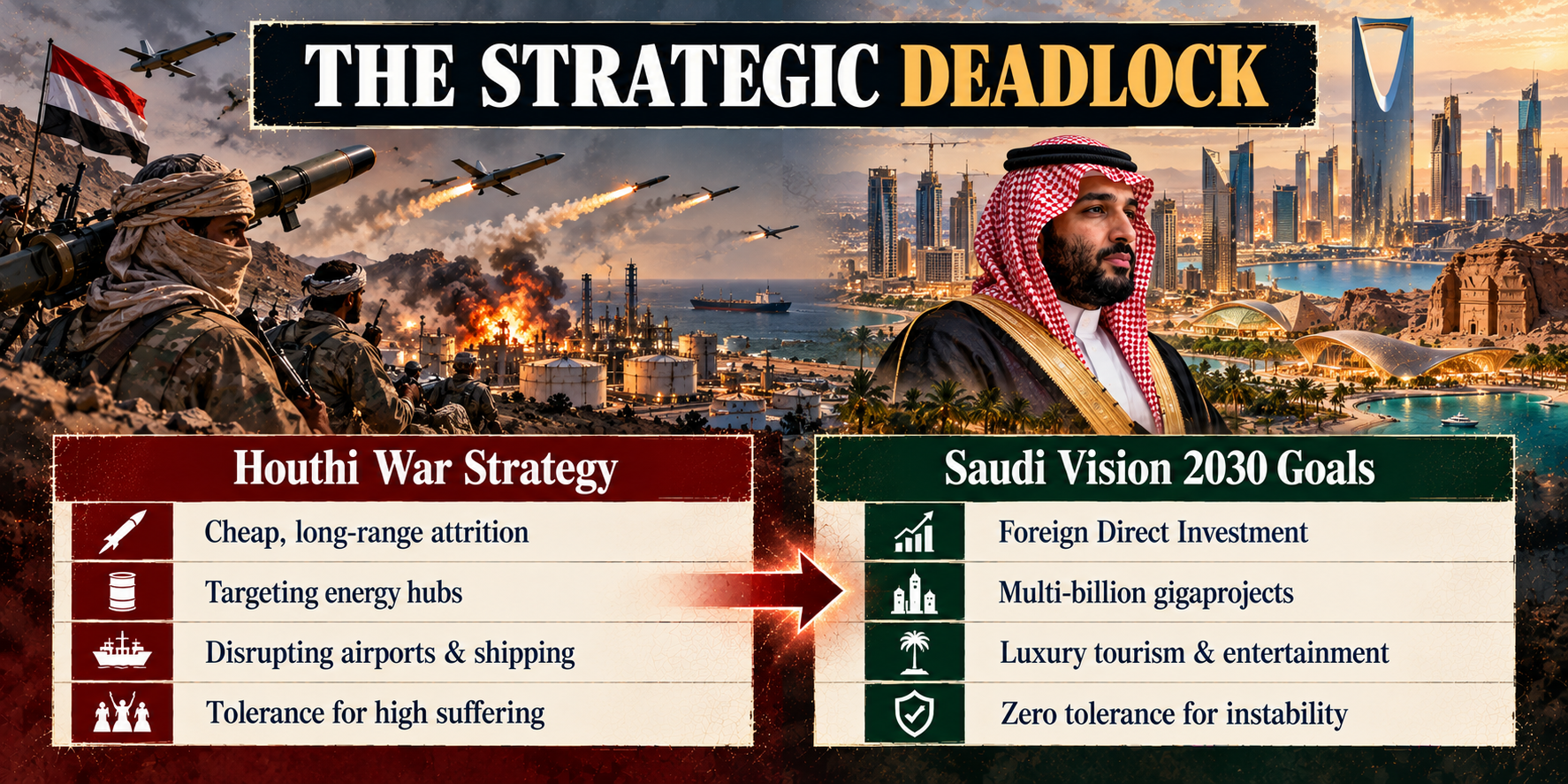
The fragility of Saudi Arabia's economic infrastructure was demonstrated on 14 September 2019, when a swarm of low-flying cruise missiles and loitering munitions struck the state oil facilities at Abqaiq and Khurais. The attack knocked out 5.7 million barrels per day—over 5% of global oil supply—in a single morning, temporarily halving the Kingdom's crude output despite billions invested in Western air defense systems designed primarily to track high-altitude ballistic trajectories rather than low-observable cruise missiles hugging terrain.
For Riyadh, the calculus shifted. The Houthis, governing an impoverished and war-ravaged population, had minimal vulnerable economic infrastructure to hold hostage. Saudi Arabia, by contrast, presented a concentrated target landscape of refineries, desalination facilities, and commercial airports. Continuing the war offered zero prospect of decisive victory, while imposing catastrophic downside risk on the Kingdom’s domestic economic modernization.
The Realist Pivot: From Military Dominance to Bilateral Détente
Recognising that conventional military force could not alter the strategic reality, Saudi Arabia adapted its policy. Riyadh deprioritised its nominal Yemeni allies in the Presidential Leadership Council (which replaced Hadi in 2022) and entered direct, bilateral talks with Houthi envoys in Muscat and Sanaa.
To insulate its territory, Saudi Arabia pursued diplomatic normalisation with Iran, signing the Beijing Agreement in March 2023 to re-establish diplomatic relations and reduce regional cross-border attacks.
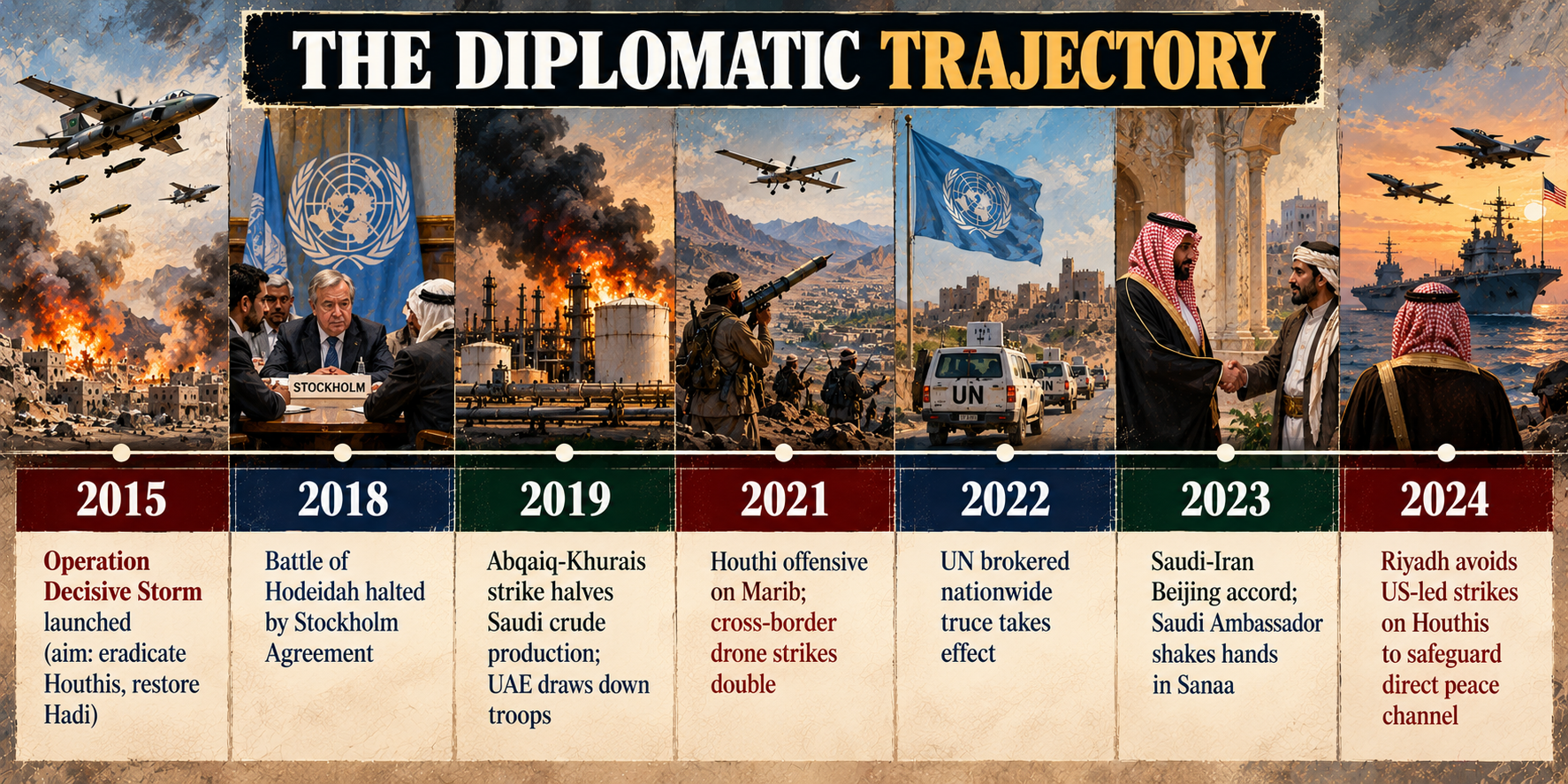
The durability of this pivot was underscored following the outbreak of the Gaza conflict in late 2023. When the Houthis began targeting commercial shipping transiting the Bab el-Mandeb strait and fired missiles toward Eilat, the United States and the United Kingdom formed a naval task force and launched strikes on Houthi radar and missile sites inside Yemen.
Significantly, Saudi Arabia refused to join Operation Prosperity Guardian and urged Washington to display restraint. Having absorbed the lessons of an eight-year conflict, Riyadh prioritised preserving its bilateral detente with Sanaa over re-entering a military confrontation it had already spent $83 billion a year trying—and failing—to win.