In brief
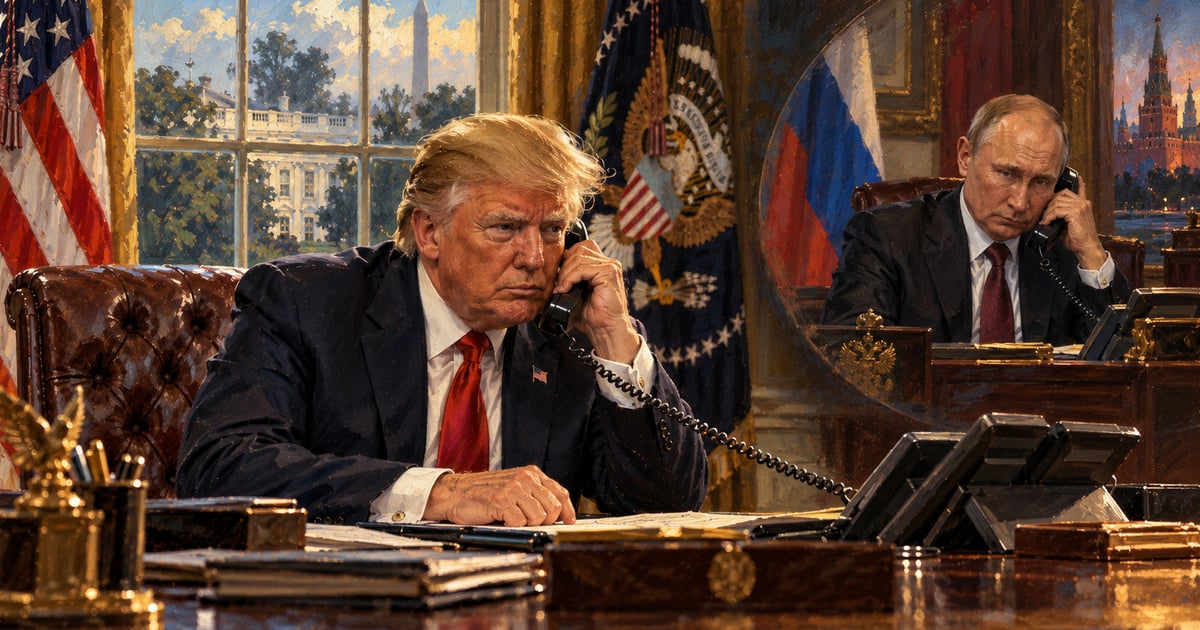
- On 9 October 2026 President Trump agreed with President Putin to allow Russian diesel imports into the United States. Treasury issued General License 135 suspending sanctions through 7 April 2027.
- The reversal followed severe diesel inflation near $4.67 per gallon, refinery bottlenecks, and Ukraine ignoring half a dozen US requests to stop striking Russian refineries.
- Russia pledged 300,000 tonnes immediately, 500,000 tonnes in November and roughly one million tonnes later. The total equals about three days of US distillate consumption.
- Ukraine called the deal an unearned gift to Putin. Congress said it breached the Lindsey Graham Sanctioning Russia Act. Allies accused Washington of double standards while EU and UK sanctions block insurance.
On Friday, 9 October 2026, the United States executed one of the sharpest foreign policy reversals of the four-year Russia–Ukraine war. President Donald Trump announced that he had reached an agreement with Russian President Vladimir Putin to supply Russian diesel to the global market and permit its direct importation into the United States.
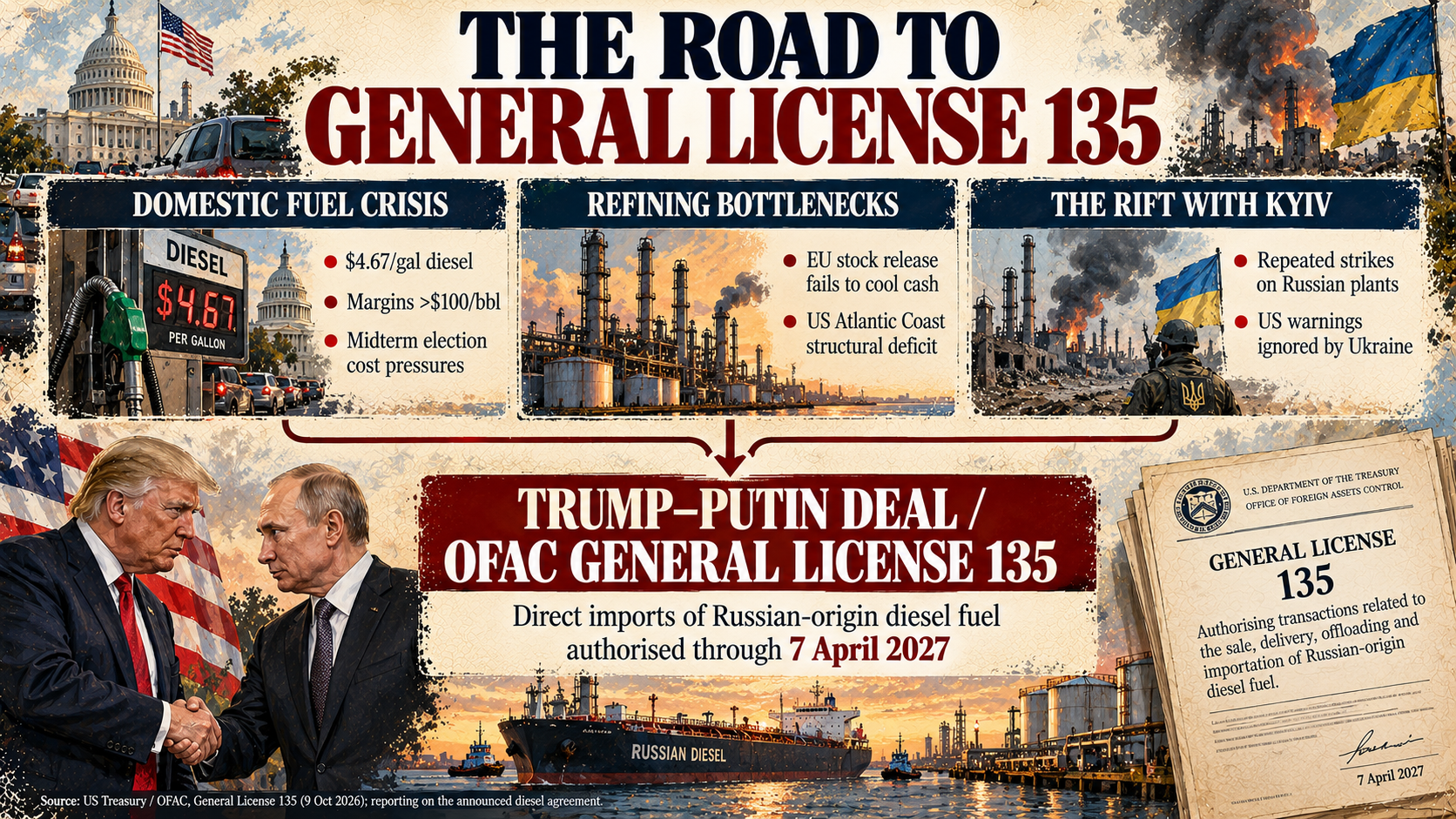
Within hours, the US Department of the Treasury's Office of Foreign Assets Control (OFAC) translated the announcement into legal reality by issuing General License 135. The authorisation suspends core prohibitions, sanctioning the sale, delivery, offloading, and importation of Russian-origin diesel through 7 April 2027.
The reversal dismantles the total embargo on Russian petroleum imports first imposed by Washington in March 2022. It comes not because the war in Eastern Europe has de-escalated, but because an acute convergence of domestic economic vulnerability, industrial refining bottlenecks, and strategic disagreements with Ukraine made the existing sanctions posture untenable for the White House.
The Terms of the Arrangement
According to statements released by Donald Trump on Truth Social and confirmed by Kremlin officials, Moscow has agreed to a phased release of refined distillate fuel:
Initial Tranche: 300,000 metric tonnes of diesel to be released immediately into international commercial channels.
November Tranche: An additional 500,000 tonnes scheduled for delivery the following month.
Subsequent Commitments: Approximately 10 lakh tonnes (1 million tonnes / 10,00,000 tonnes) pledged in subsequent phases.
In volume terms, the initial 300,000 tonnes equates to roughly 22 lakh barrels (2.2 million barrels / 22,00,000 barrels) of diesel. While that represents just over half a day of domestic US distillate consumption—which averages roughly 40 lakh barrels (4 million barrels) daily—its financial and psychological target was the global pricing benchmark.
Treasury’s General License 135 explicitly permits US financial institutions and shipping companies to finance, insure, transport, and offload these cargoes directly at American ports, providing legal cover that European and British regulations still strictly prohibit.
Why Did the US Step Back?
The administration’s pivot was driven by three interrelated pressures: domestic fuel inflation, structural refinery shortages, and an escalating dispute with Ukraine over attacks on Russian energy infrastructure.
1. Severe Distillate Inflation Ahead of the Midterms
Diesel is the primary fuel of the American supply chain, powering freight trains, long-haul heavy goods vehicles, agricultural machinery, and industrial logistics. In early October 2026, New York diesel futures hovered near $4.67 per gallon, pushing retail pump prices well above $5.50 in several commercial transit corridors.
With West Texas Intermediate (WTI) crude trading near $90.50 per barrel, the "crack spread"—the profit margin refiners extract by turning crude oil into diesel—widened beyond $100 per barrel. American refiners were charging near $196 per barrel for finished distillate.
With the US midterm congressional elections weeks away, elevated transport costs were feeding directly into grocery prices, distribution surcharges, and haulage margins. In his announcement, Donald Trump placed domestic economic relief at the forefront:
"Lower prices for Americans, especially our Great Farmers, Ranchers, and Truckers, is my Greatest Priority."
Previous administrative measures had failed to stem the rise. On 2 October, the White House persuaded European allies to endorse a French proposal tapping strategic diesel stockpiles, but the market absorbed the volume with minimal price softening. Faced with persistent backwardation in heating oil and ultra-low-sulfur diesel contracts, the White House sought physical volumes from the only supplier capable of delivering spot export cargoes rapidly: Russia.
2. The Strategic Rift Over Ukraine’s Refinery Strikes
The economic squeeze was intensified by Ukraine's military strategy. Over late summer and early autumn 2026, the Ukrainian Armed Forces escalated their deep-strike drone campaign against Russian primary refining infrastructure, targeting fluid catalytic cracking units and crude distillation towers in Ryazan, Samara, and Volgograd.
The strikes intended to starve Moscow of export revenues and create domestic fuel shortages within the Russian armed forces. However, they also removed refined distillate volumes from an already tight global market, amplifying international crack spreads.
According to reporting by Axios citing a senior US official, Washington repeatedly warned Kyiv to alter its target selection:
"President Trump decided to make a diesel fuel deal with Russia after Ukrainian President Volodymyr Zelensky ignored half a dozen U.S. requests to stop attacking Russian oil refineries."
The official observed that Kyiv's persistence had damaged its standing in the Oval Office: "Zelensky is misreading the room. By continuing to hit refineries, he is eroding the good will that he has built with Trump over the last six months."
When diplomatic entreaties failed to stop the Ukrainian strikes, the White House engaged directly with Moscow to restart fuel flows.
The Domestic and Geopolitical Fall-Out
The unilateral implementation of General License 135 has generated fierce blowback across three distinct arenas: Kyiv, Capitol Hill, and the broader international alliance.
Kyiv: "A Gift to Putin"
In an interview with Axios following the announcement, President Volodymyr Zelensky criticised the arrangement in uncompromising terms. Calling the deal "not fair and not honest", Zelensky argued that lifting sanctions without securing an energy ceasefire or concessions from Moscow amounted to an unwarranted strategic concession.
Pointing to Vladimir Putin’s 74th birthday on 7 October, Ukrainian officials characterised the licence as an unearned gift that provides Moscow with hard currency while Russian missiles continue to target Ukraine's civilian power grid. Zelensky further remarked that the decision looked like "Alaska number two", signalling Kyiv's fear of bilateral diplomacy conducted over Ukraine's head.
Capitol Hill: Statutory and Bipartisan Friction
The deal creates immediate statutory friction in Washington. On 18 September 2026, Donald Trump signed the bipartisan Lindsey O. Graham Sanctioning Russia and Iran Act of 2026, designed to tighten enforcement on Russian hydrocarbon revenues.
Members of the Congressional Ukraine Caucus, including Representative Brian Fitzpatrick (R-PA), had backed the statute specifically to deprive the Russian military apparatus of operational funding. While Section 114(h) of the Act formally protects Treasury’s discretion to grant general licences, several congressional leaders have labelled the diesel exemption a breach of the statute's legislative intent. Democratic senators, including Chris Coons (D-DE), described the move as a betrayal of allied security commitments.
International Markets: Charges of Double Standards
The agreement has also drawn accusations of hypocrisy from international partners, particularly in India. Throughout 2023, 2024, and 2025, American diplomats routinely cautioned New Delhi against expanding purchases of discounted Russian crude or exporting products refined from Russian feedstocks.
Commentators across Asian energy hubs quickly observed that when domestic inflation threatened American political fortunes, Washington proved willing to suspend its own sanctions rules while expecting its partners to adhere to them.
Immediate Market Reaction and Structural Realities
Following the announcement and the publication of General License 135, global energy benchmarks reacted immediately:
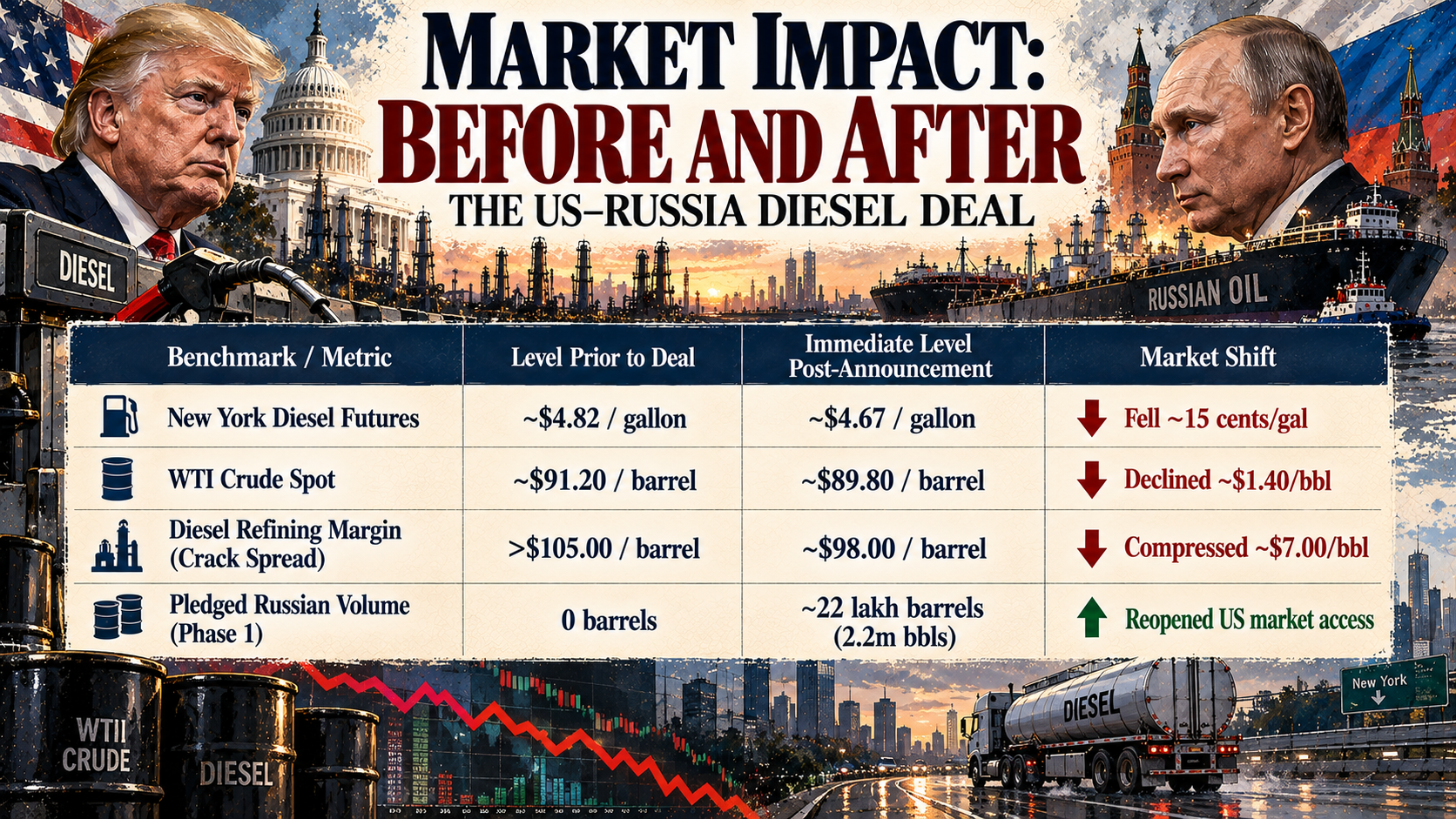
Energy analysts caution that while the headlines exerted downward pressure on financial futures, the physical relief may prove limited. Russia’s total promised allocation across all three phases—approximately 18 lakh tonnes (1.8 million tonnes / 18,00,000 tonnes), or roughly 1.3 crore barrels (13 million barrels / 1,30,00,000 barrels)—equals barely three days of total US distillate consumption.
Furthermore, shipping Russian product across the Atlantic involves substantial logistical lead times and compliance hurdles. European Union and United Kingdom sanctions on maritime insurance and tanker operations remain unchanged, meaning shippers carrying Russian cargoes under the US licence cannot use London maritime insurance syndicates.
Conclusion: Tactical Relief vs Strategic Precedent
Washington’s decision to open US ports to Russian diesel demonstrates the strict limits of economic warfare when it collides with domestic consumer politics. Faced with an electorate sensitive to freight and pump prices weeks ahead of the 2026 midterms, the Trump administration concluded that domestic price stability superseded the integrity of the energy blockade.
By stepping back, the White House secured brief downward momentum in diesel futures. However, it achieved that relief at substantial geopolitical cost: alienating Ukraine, dividing its NATO allies, opening up statutory disputes with Congress, and providing Moscow with a significant diplomatic and economic precedent.