In brief
- A four hour nationwide ground stop grounded flights across the United States after a telecommunications failure affected air traffic control systems, cancelling nearly 10,000 flights and disrupting operations.
- Officials attributed the outage to ageing hardware and old copper lines, saying the system was an old one that went down and got overloaded which affected controllers and prompted the safety shutdown.
- CBS News and other sources reported that an update to the FAA Telecommunications Infrastructure linked to the private network caused the system to reboot and crash, with new security patches appearing to overwhelm routers.
- The crisis is described as a collision between modern software maintenance and legacy networking, with administration officials noting the older 1980s hardware and the newer software patches contributing to the failure.
At 3:54 p.m. EST (20:54 UTC) on Friday, 13 November 2026—the early hours of Saturday morning in India—the Federal Aviation Administration (FAA) ordered every departing flight across the United States to stay on the ground (CBS News). A telecommunications failure had struck the agency’s 22 Air Route Traffic Control Centers (ARTCCs), the regional facilities that guide aircraft once they leave airport towers and enter cruising airspace.
By the time the ground stop was lifted 4 hours and 21 minutes later at 8:15 p.m. EST (01:15 UTC on 14 November), US aviation was in deep operational recovery mode. When the order took effect, 4,042 flights were airborne and bound for US airports; by 01:29 UTC, that number had collapsed to 336, compared with more than 3,600 on a normal Friday night (Flightradar24). By Saturday morning UTC, Flightradar24 counted nearly 10,000 cancelled flights to and from US airports through Saturday—including more than 2,200 each at Delta and American, 1,800 at United, and nearly 1,400 at Southwest—while Cirium estimated 1.5 million passengers were stranded (Investing.com).
It was only the third nationwide ground stop in US history, following the 11 September 2001 attacks and a 90-minute pause in January 2023 when a pilot-notification database failed (The Hindu; Flightradar24).
Was "Old Tech" Really to Blame?
At Friday night’s White House briefing, Transportation Secretary Sean Duffy pinned the shutdown squarely on ageing hardware. "We have old, old switches, old routers," Duffy said. "We use 1980s little copper lines. It's an old system that went down, and went down everywhere. It got overloaded." (The Hindu). Once overloaded routers began feeding inconsistent data to controllers, the FAA shut the system down as a safety precaution (CBS News).
That explanation is half the story. Legacy copper lines do not spontaneously fail across 22 regional centres at the exact same minute on a Friday afternoon without a trigger.
Multiple sources told CBS News that an update to the private telecommunications network linking US air traffic control—the FAA Telecommunications Infrastructure (FTI), operated by defence contractor L3Harris Technologies—caused the system to reboot and crash. Speaking alongside Duffy on Friday night, Homeland Security Secretary Markwayne Mullin offered a matching technical clue: new security patches introduced into the older system appeared to "overwhelm" its routers (CBS News).
In other words, the crisis was a collision between modern software maintenance and legacy networking. The FAA has not yet published a formal post-mortem, and it pushed back against media reports calling the event a "software outage", while L3Harris declined immediate comment (Nacionale).
Inside the 24-Year-Old Backbone
The FAA awarded the FTI contract to Harris Corporation (now L3Harris) in July 2002 to carry essential voice communications and flight data between control centres (CBS News). Much of that network still relies on time-division multiplexing (TDM)—a circuit-switched architecture designed decades ago—running over legacy copper lines.
The fragility was documented long before Friday:
November 2023: An FAA-commissioned safety review described FTI as obsolete, warned that TDM equipment was no longer supported by modern telecoms infrastructure, and cautioned that an unexpected failure could disconnect entire regional air traffic control centres (CBS News).
September 2025: Two severed fibre-optic cables knocked out radar and communications for Dallas Fort Worth and Dallas Love Field for five hours, with the FAA faulting L3Harris for failing to ensure backup redundancies worked (Nacionale).
May 2026: The Government Accountability Office (GAO) reported that the FAA had replaced only 2,560 of 5,170 targeted legacy copper connections—barely half—while L3Harris said its own IP-upgrade work would not finish until 2027 (Sherafy; Nacionale).
Replacing FTI altogether has also been slowed by procurement reversals. In March 2023, the FAA chose Verizon under a $2.4 billion, 15-year contract known as FAA Enterprise Network Services (FENS) to build an internet-protocol replacement. On 11 August 2026, however, the FAA switched prime contractors to AT&T to meet a December 2028 operational deadline for its broader overhaul (Nacionale).
What Did Not Cause the Grounding
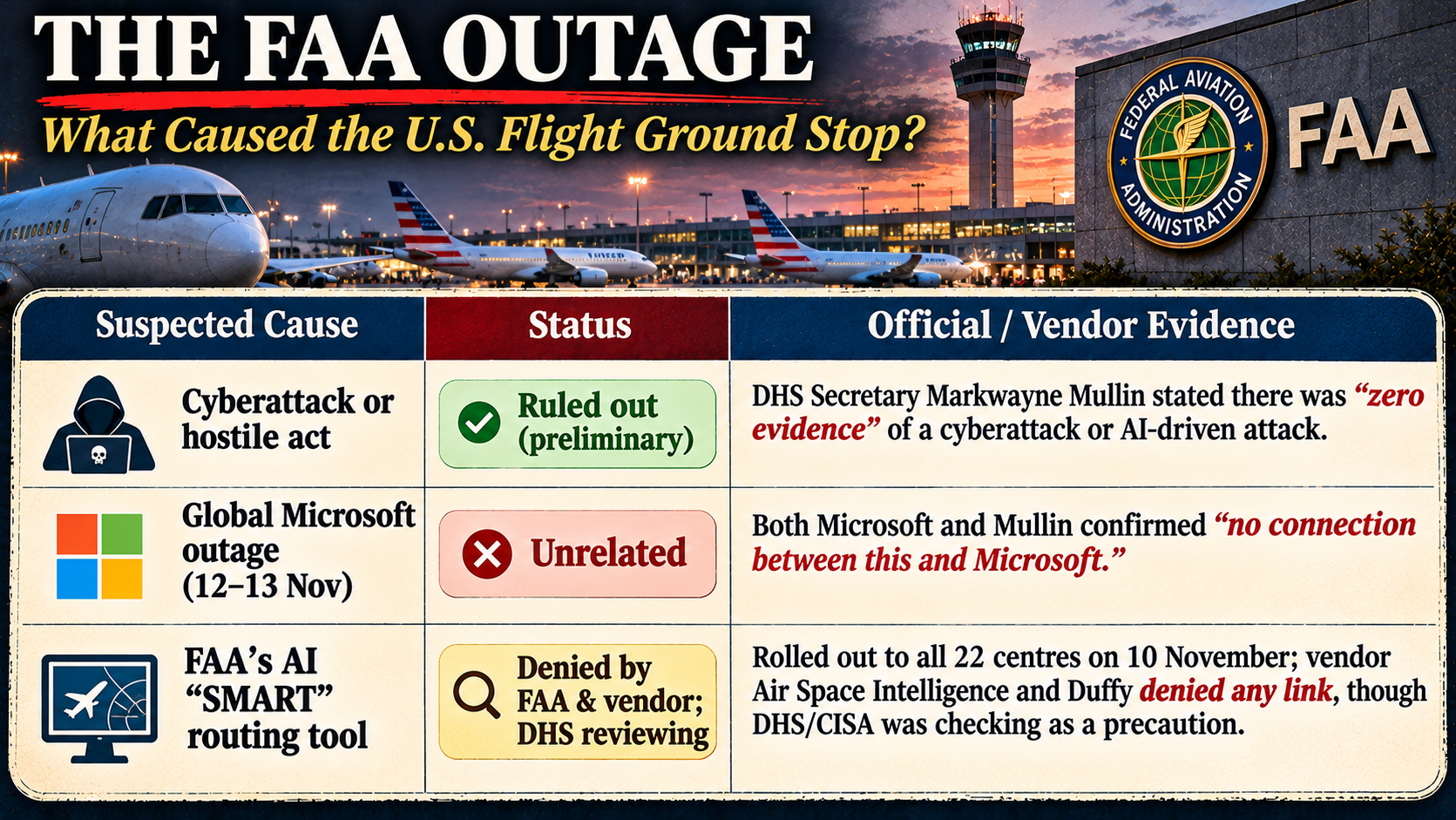
Because the outage struck on the heels of two major tech events earlier in the week, speculation spread quickly online. Officials and vendors moved rapidly to rule out three theories:
The $50 Billion Political Fight Ahead
The outage landed less than 24 hours after Duffy had formally asked Congress for $30.1 billion to modernise the air traffic control system, on top of $12.5 billion already appropriated (The Hindu; Nacionale). By Friday night, Mullin estimated a full replacement of US air traffic control would cost "about $50 billion", with Duffy warning lawmakers: "You will have more of them unless the American people and the Congress tell us to build." (CBS News).
For travellers, the immediate concern is simpler. Even with US airspace reopened, aircraft and flight crews remain scattered across the wrong cities ahead of the peak Thanksgiving travel rush—meaning residual delays and cancellations will ripple through the weekend.