
In brief
- Foreign institutional investors pulled out nearly $63.6 billion from Indian equities since October 2024, turning an eleven year net foreign flow from October 2015 to October 2026 into negative territory.
- Between October 2015 and October 2024 FIIs deployed a cumulative net balance of about $63.5 billion into Indian equities, roughly ₹5.28 lakh crore.
- In 2025 FII funds unloaded a record ₹1.66 lakh crore in direct equity, and in the first ten months of 2026 more than $33 billion was dumped, with September 2026 net sales at $4.1 billion.
- The reversal happened in two phases: an initial sell-off through 2025 followed by accelerated exodus in 2026, driven by macro factors such as the risk free dollar hurdle and higher yields.
Between October 2015 and October 2024, foreign institutional investors (FIIs) deployed a cumulative net balance of approximately $63.5 billion (around ₹5.28 lakh crore) into Indian equities. It took nine years of economic overhauls, digital infrastructure rollout, corporate tax cuts, and domestic manufacturing drives to draw that capital into Mumbai.
It took exactly twenty-four months for it to leave.
According to data compiled by Motilal Oswal Financial Services and reported by The Economic Times, overseas portfolio managers have pulled out nearly $63.6 billion (around ₹5.29 lakh crore) from Indian equities since October 2024. That retreat has driven the cumulative 11-year net foreign flow from October 2015 to October 2026 into negative territory, standing at approximately minus $110 million (negative ₹915 crore).
Eleven years of foreign net buying have been reduced to zero.
Yet benchmark indices have not suffered the devastating currency and liquidity collapses that accompanied the taper tantrum of 2013 or the subprime contagion of 2008. Understanding why this mathematical round trip occurred—and why the sky did not fall on Dalal Street—requires untangling global macro incentives, the mechanics of foreign exchange custody, and a structural shift in who sets prices in India's capital markets.
The Anatomy of the $64 Billion Reversal
The timeline of the capital withdrawal unfolded in two distinct phases: an initial sell-off through 2025 followed by an accelerated exodus throughout 2026.
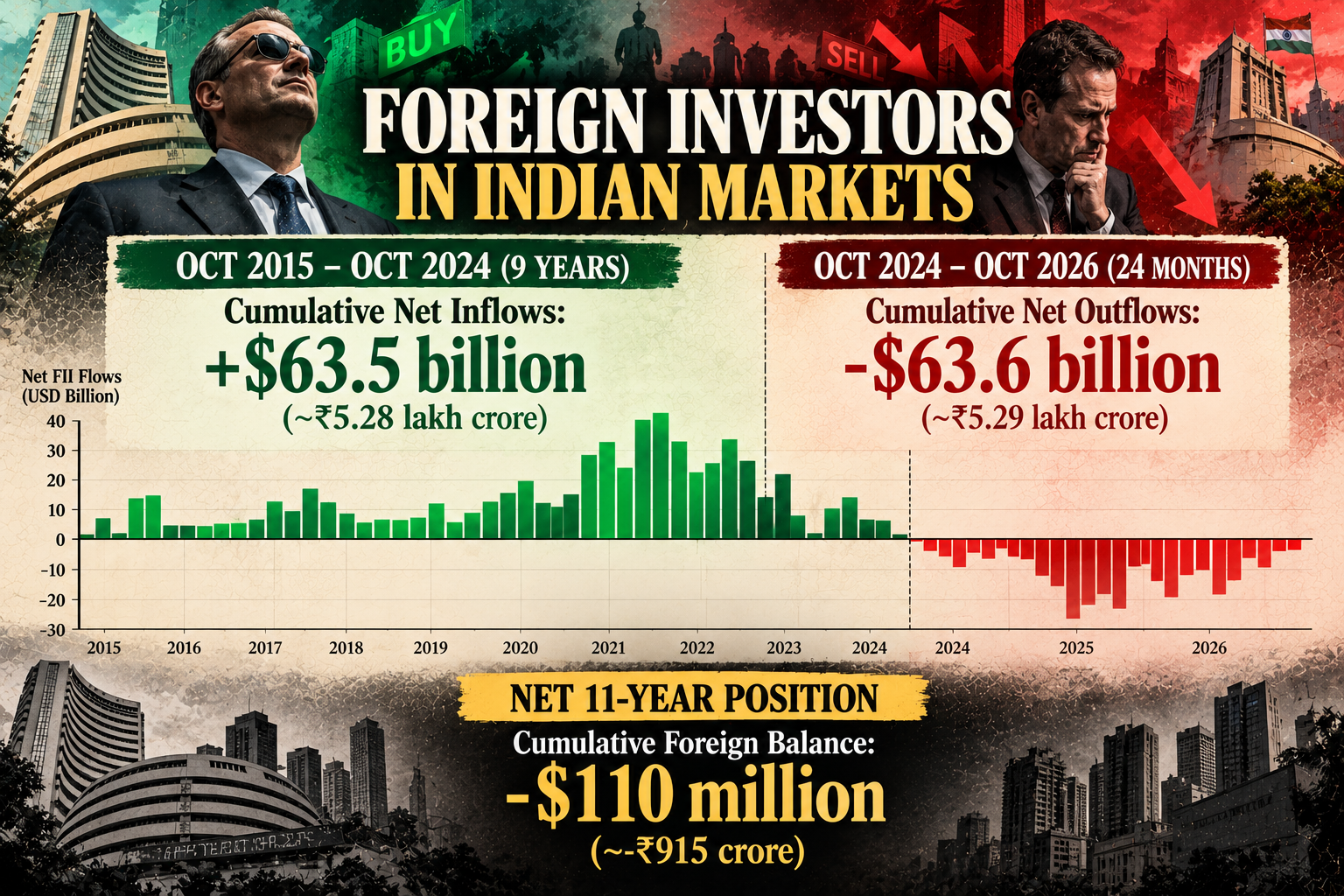
In 2025 alone, foreign institutional funds unloaded a record ₹1.66 lakh crore ($20 billion) in direct equity. The momentum did not abate in 2026. Official depository records from the National Securities Depository Limited (NSDL) show foreign portfolio investors dumped more than $33 billion (around ₹2.75 lakh crore) in the first ten months of 2026. By September 2026, monthly FII net sales touched $4.1 billion (₹34,100 crore), according to Motilal Oswal.
Three primary global macro levers catalyzed this persistent withdrawal:
The Risk-Free Dollar Hurdle: With US ten-year Treasury yields stubborn above 4.5% and policy rates lingering near 5.3%, the equity risk premium for emerging markets collapsed. As Amnish Aggarwal of PL Capital noted, attracting sustained risk capital into emerging markets becomes difficult when sovereign dollar paper offers guaranteed yields of over 5%.
Extreme Valuation Premiums: By mid-2024, Indian equities traded at record valuation premiums relative to their emerging market peers. The Nifty 50 was commanding one-year forward price-to-earnings multiples exceeding 22 times, while broad Emerging Market indices languished near 11 to 13 times. Any moderation in domestic earnings growth left international funds exposed to valuation compressions.
The Artificial Intelligence Capital Rotation: Perhaps the most decisive structural shift was industrial. Global technology capital congregated around hardware, foundries, and advanced packaging in Taiwan and South Korea, and cloud infrastructure in the United States. Indian technology exporters, concentrated in traditional enterprise services, were largely bypassed by the initial generative AI capital expenditure surge.
The "Easy Exit" Conundrum
Addressing the International Monetary Fund and World Bank annual meetings in Bangkok, Finance Minister Nirmala Sitharaman pointed directly to an ironic vulnerability created by India’s financial modernisation: liquidity.
Speaking to CNBC and reported by NDTV Profit, the Finance Minister argued that excess domestic liquidity and efficient trading infrastructure had paradoxically made Dalal Street an easy target for fund liquidations:
"Because of the ease of liquidity, ease of availability, people are even exiting easily."
Sitharaman highlighted the flight of capital toward AI and the United States, identifying continued overseas capital flight as one of the chief risks confronting Indian markets heading into 2027.
When international global asset allocators received redemption notices or opted to chase runaway semiconductor valuations in Taipei or Seoul, selling down large positions in illiquid emerging markets carried painful market impact costs. In India, however, deep counter-cyclical domestic bids and streamlined $T+1$ settlement meant global desks could exit hundreds of millions of dollars without crashing the market against their own orders. Dalal Street served as a convenient liquidity tap.
Flow Versus Stock: Why Zero Net Flow Does Not Mean Zero Ownership
Headlines trumpeting "zero net FII flows in 11 years" encourage a common misconception: that foreign investors have walked away with all their money and now hold nothing in India.
This confuses net financial flows with asset ownership.
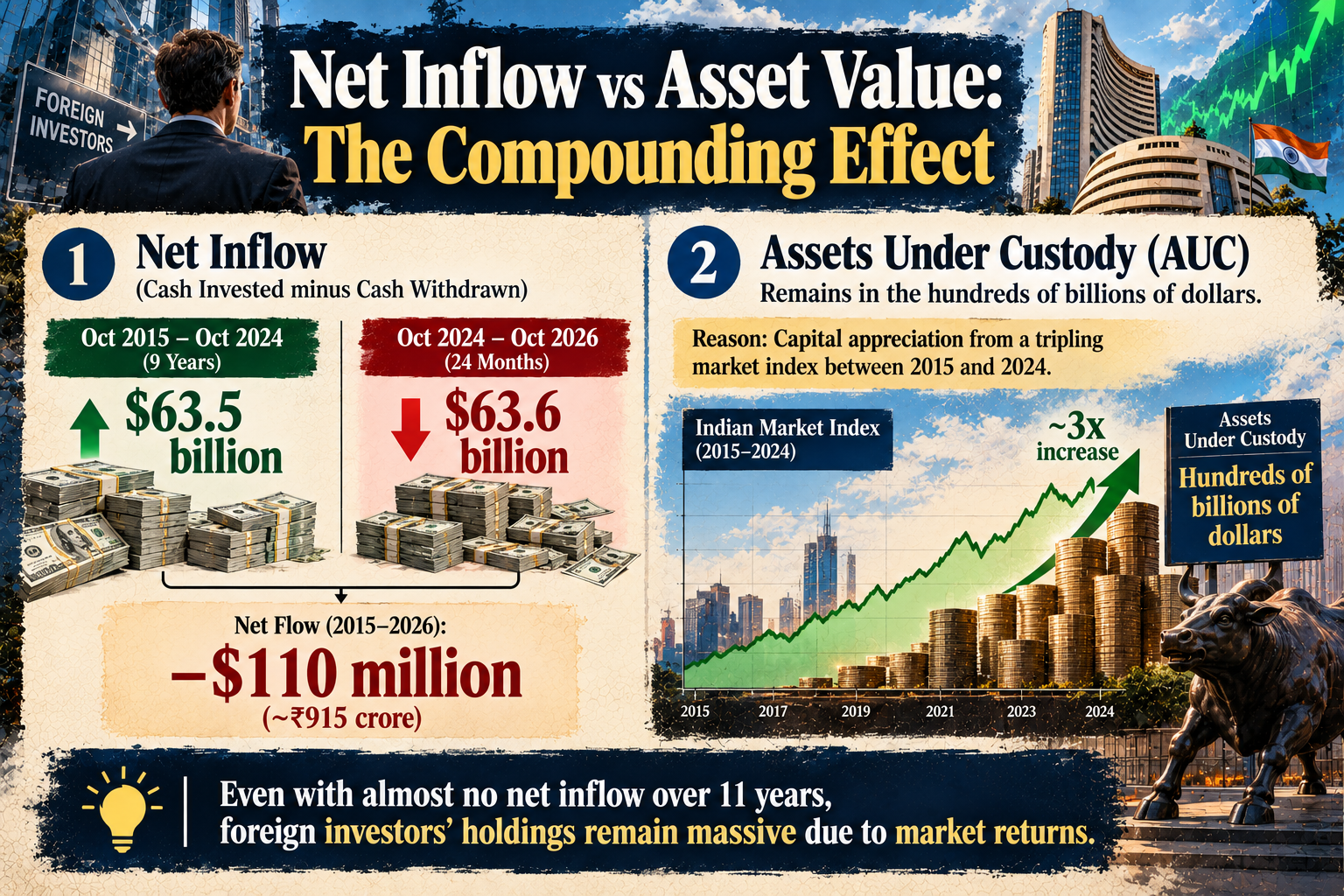
As analysts at Kotak Institutional Equities have emphasised, cumulative flow data measures only cash entering the exchange against cash leaving it. It ignores the enormous capital appreciation generated during the intervening bull market.
A fund that invested $100 million in Indian large caps in late 2015 would have seen those holdings triple in value by late 2024 as the BSE Sensex expanded from the 27,000 range to peaks above 85,000. If that same fund pulled out its initial $100 million principal in 2025, its net flow over the decade would read zero. Yet it would still retain roughly $200 million in mark-to-market value on Dalal Street.
The $64 billion outflow reflects aggressive profit extraction and tactical underweighting, not a terminal abandonment of the Indian corporate sector. Foreign portfolio investors remain substantial institutional shareholders across Indian private banking, automobiles, and telecommunications.
The Domestic Cushion: Why Dalal Street Did Not Break
A decade ago, an FII dump of this magnitude would have shattered the rupee and dragged Indian equities into an extended bear market. Yet despite benchmark indices sliding nearly 12% to 13% across 2026, the correction has remained an orderly repricing rather than a systemic rupture.
The fundamental stabilizer has been the structural rise of the Indian domestic investor.

Data from the Association of Mutual Funds in India (AMFI) confirms that domestic equity mutual funds have recorded positive net inflows in every consecutive month since March 2021. In September 2026 alone, as foreign accounts unloaded $4.1 billion, domestic institutions deployed nearly $8 billion (around ₹66,500 crore)—comfortably absorbing foreign selling pressure.
Monthly SIP books, funded by tens of millions of domestic retail accounts, have transformed Indian equities from an FII-dependent satellite market into an internally capitalized financial ecosystem.
The Road Ahead: What Restores Overseas Capital?
Foreign flows are cyclical. While the past twenty-four months demonstrated that domestic capital can prevent an index crash, an extended FII buyers' strike imposes distinct costs: it tightens foreign currency liquidity, pressures the rupee against the US dollar, and caps broad valuation multiples for capital-intensive sectors.
For foreign institutional capital to stage a durable return, three shifts are required:
Valuation Normalisation: The 12% to 13% index pullback in 2026 has narrowed the valuation gap between Indian equities and the broader MSCI Emerging Markets basket, creating more defensible entry yields for global value mandates.
Earnings Acceleration: Overseas investors demand underlying earnings growth of 14% to 16% to justify currency risk. Clear signs of rural consumption revival and private capital expenditure recovery will be required to renew foreign appetite.
Global Rate Cycle Pivot: A meaningful easing cycle from the US Federal Reserve, accompanied by softer US Treasury yields, would compress the attractive dollar hurdle rate and re-energise capital allocations into emerging market equities.
The 11-year reset serves as a clarifying moment for Indian finance. It dismantled the lingering illusion that foreign capital is sticky or ideological: global funds bought when risk-adjusted spreads were wide, and sold when alternative trades proved more compelling. But it also proved that Dalal Street no longer trades at the exclusive pleasure of overseas allocators.