In brief
- Adani Airport Holdings told airlines to move 265 of 770 weekly international flights from Mumbai's Terminal 2 to Navi Mumbai by 25 October 2026 to free space for Terminal 1 redevelopment.
- The Airline Operators Committee and IATA refused the move, prompting the Ministry of Civil Aviation on 6 October 2026 to freeze the cuts and order AAHL to negotiate with carriers.
- Airlines cited hub disruption, bilateral treaty limits, duplicated ground costs and loss of premium traffic as reasons to keep international flights at Terminal 2.
- The ministry set a stakeholder summit for 13 October 2026 and a follow up on 20 October 2026 to draft a Major Development Plan and agree a phased transition.
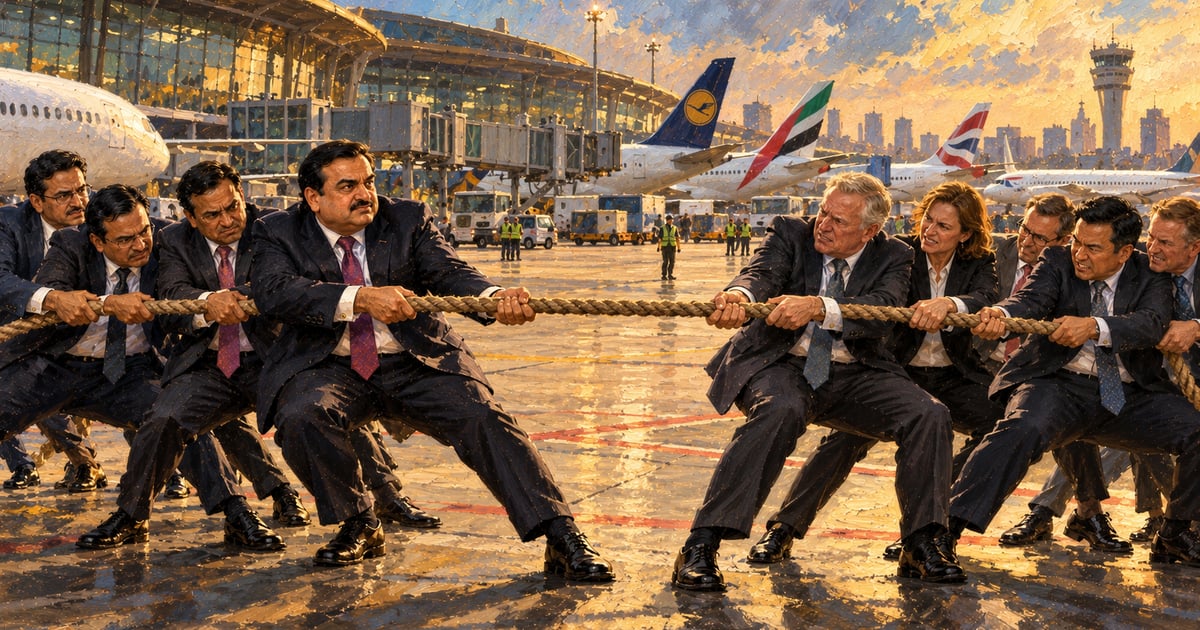
A bitter confrontation between India’s largest private airport operator and the international airline community has forced the Union Ministry of Civil Aviation to intervene, temporarily halting an aggressive operational shake-up across Mumbai's airspace.
At the centre of the dispute is Adani Airport Holdings Limited (AAHL), which operates both the land-constrained Chhatrapati Shivaji Maharaj International Airport (CSMIA) in Santacruz/Sahar and the newly commissioned Navi Mumbai International Airport (NMIA) in Ulwe. Seeking to begin a long-delayed phased redevelopment of Mumbai's ageing Terminal 1 (T1), the airport operator instructed commercial airlines to shift 265 of their 770 weekly international departures to Navi Mumbai by 25 October 2026.
The proposal was met with an immediate, coordinated refusal from commercial carriers, represented by the Airline Operators Committee (AOC) and the International Air Transport Association (IATA). Confronted by an operational crisis weeks before the winter scheduling season, the Ministry of Civil Aviation (MoCA) stepped in on 6 October 2026, freezing the mandatory flight cuts and ordering AAHL to engage in structured negotiations with airlines.
This dispute is not merely a logistical spat over terminal real estate. It exposes the structural frictions of privatised dual-airport monopolies, the legal limits of international bilateral traffic rights, and the immense operational complexities of reconstructing an active aviation hub while attempting to jumpstart a greenfield replacement.
The T1 Conundrum: Why Adani Wants Flights Moved
Mumbai’s CSMIA is one of the world's most congested single-runway-dominant airports, handling over 950 aircraft movements daily and processing over 5 crore passengers (50 million passengers) annually across two distinct campuses separated by operational runways:
Terminal 1 (Santacruz): Dedicated exclusively to domestic low-cost flights (chiefly IndiGo and Akasa Air), processing roughly 1.5 crore passengers (15 million passengers) per year.
Terminal 2 (Sahar): An integrated terminal handling roughly 4 crore passengers (40 million passengers) annually, accommodating all international departures alongside full-service domestic operations.
Terminal 1 is an ageing, fragmented facility dating back over 60 years. In August 2026, Mumbai International Airport Limited (MIAL) notified the civil aviation ministry of its intention to initiate a phased teardown, beginning with the demolition of the North Section of Terminal 1-B on 15 January 2027.
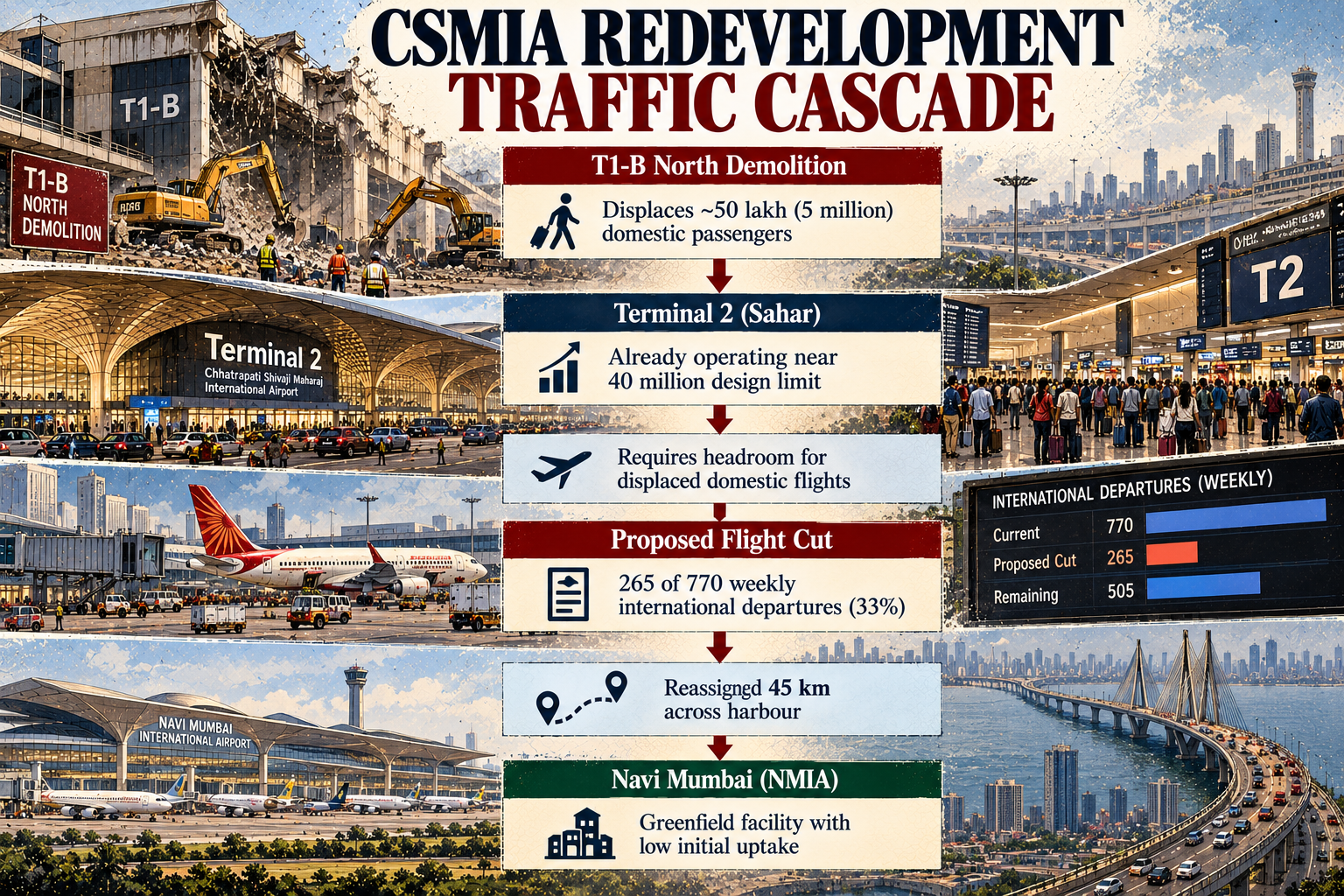
The demolition of Terminal 1-B North will temporarily eliminate handling capacity for approximately 50 lakh passengers (5 million passengers) annually. Because Adani cannot halt domestic operations without causing domestic airfare spikes, the operator planned to absorb these displaced domestic flights into Terminal 2.
However, Terminal 2 is already operating near peak capacity. To clear the required aprons, security queues, and boarding gates, MIAL determined that international operations would have to absorb the blow. In late September, MIAL issued a formal notice requesting airlines to reallocate roughly 33% of international departures from T2 to Navi Mumbai by the start of the winter schedule on 25 October 2026, setting a deadline of 6 October for airlines to surrender slots voluntarily or face administrative reallocation.
Arun Bansal, Chief Executive Officer of AAHL, defended the move on grounds of passenger welfare: "Extensive consultations with airlines on the future of Terminal 1 have been ongoing since 2020, and the proposed redevelopment was also presented before AERA (Airports Economic Regulatory Authority) and subsequently incorporated into the approved tariff framework. While we appreciate the concerns expressed by certain airlines, passenger safety must remain paramount."
Why Airlines Resisted: The Core Grievances
The airline fraternity’s resistance was immediate, vehement, and multifaceted. Foreign flag carriers, domestic network operators, and international trade bodies united around several core operational and legal objections.
1. The Disruption of Transfer Hub Economics
Modern international aviation relies on hub-and-spoke connectivity. A significant proportion of passengers arriving on long-haul flights from London, Dubai, Frankfurt, or Singapore transfer directly onto domestic connections to tier-two and tier-three Indian cities.
Under MIAL’s relocation blueprint, international flights would touch down at NMIA in Ulwe, while the domestic feeder network would remain anchored at CSMIA in Santacruz and Sahar—separated by 45 kilometres of urban congestion. Without an operational high-speed metro link (such as the planned Mumbai Metro Line 8), transit passengers would face a road transfer across the Mumbai Trans Harbour Link (Atal Setu) lasting anywhere from 75 to 120 minutes, rendering tight two-hour flight connections completely impossible.
2. Bilateral Air Services Agreements (BASAs)
International routes are governed by treaties between sovereign nations. In their respective Bilateral Air Services Agreements, foreign carriers hold designated traffic rights specifically to the city pair involving Mumbai's historical airport (CSMIA / BOM).
Airlines argue that an airport operator possesses no sovereign legal authority to redirect a foreign carrier holding bilateral rights for BOM to an entirely different airport jurisdiction (NMIA / NMI). Modifying these designations requires bilateral diplomatic consultation and formal approvals from civil aviation authorities in both countries.
3. Dual-Station Cost Penalties
Operating across two airports within the same metropolitan region doubles an airline's fixed ground overheads. Carriers forced to split their operations would require:
Duplicate station managers, check-in staff, and ground handling teams.
Separate line maintenance spares, engineering crews, and aircraft turnaround tooling.
Duplicate catering contracts and dedicated crew accommodation facilities in Navi Mumbai.
For foreign carriers operating only one or two daily flights into Mumbai, splitting operations or moving to an unproven greenfield airport undermines route profitability.
4. Prime Slot Economics and Commercial Resistance
Mumbai’s prime international departure bank—clustered heavily between 10:00 PM and 3:00 AM—represents some of the most commercially lucrative real estate in global aviation. Moving to Navi Mumbai, an airport that business travellers perceive as distant from the commercial epicentres of Nariman Point, Bandra-Kurla Complex (BKC), and Lower Parel, risks shedding high-yielding premium corporate traffic to competitors that retain slots at T2.
Contradictions and Historical Records: The AOC Pushback
Airlines have also challenged the factual foundation of AAHL’s public stance. The Airline Operators Committee (AOC) directly rebuffed AAHL's assertions regarding long-standing stakeholder alignment in an official rejoinder reviewed by Business Standard.
The AOC pointed out that while AAHL claimed "extensive consultations with airlines on the future of T1 have been ongoing since 2020", the Adani Group did not even hold management control of MIAL in 2020; it completed the formal acquisition of the concession from the GVK-led consortium in mid-2021. The AOC formally requested that MIAL produce all minutes of meetings, consultation records, and documented agreements dating back to 2020 to substantiate its claim that airlines had consented to this transition.
Furthermore, on 9–11 October 2026, ahead of scheduled tripartite talks, the AOC submitted a six-point agenda demanding full structural and operational transparency from MIAL:
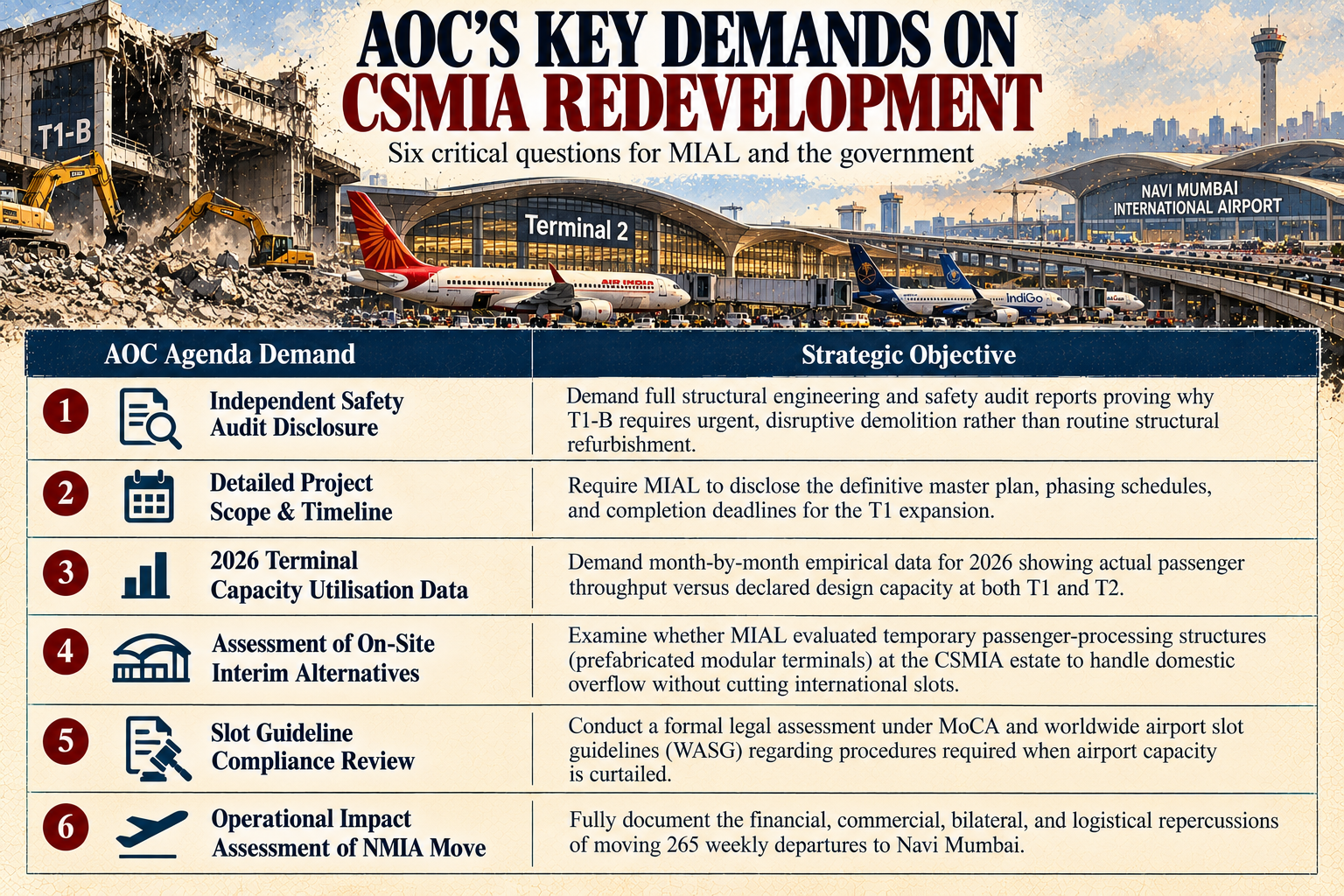
The committee maintains that empirical utilisation data will reveal whether Terminal 2 is genuinely incapable of absorbing temporary domestic traffic through operational optimisations—such as peak-hour de-peaking, bussing gates, and reconfigured security lanes—before forcing international carriers to abandon slots.
The Regulatory Freeze and Political Firestorm
Recognising the potential for widespread flight cancellations and diplomatic friction, the Ministry of Civil Aviation acted swiftly. On 6 October 2026, the ministry directed MIAL to suspend its unilateral 25 October slot-reduction mandate.
The ministry instructed AAHL to return to the drawing board, submit a formal Major Development Plan (MDP) for the Terminal 1 reconstruction, and achieve consensus through an agreeable transition framework. A structured negotiation schedule was established:
13 October 2026: Preliminary stakeholder summit between MIAL, domestic carriers, international airlines, and ground handlers to address the AOC's six agenda points.
20 October 2026: Follow-up session aimed at establishing an agreed, phased transition roadmap.
The standoff has also ignited political debate across Maharashtra. Aaditya Thackeray, legislator and leader of the Shiv Sena (UBT), publicly condemned the forced flight diversions: "Navi Mumbai is an additional airport, not a makeshift airport! Who is it being done for? Rebuild Mumbai Airport T1 without forcing airlines or passengers to move to NMIA."
Opposition figures have alleged that Adani Airports is using T1's structural redevelopment as an artificial mechanism to steer airline traffic and commercial viability towards Navi Mumbai, where heavy capital expenditures require immediate aeronautical and non-aeronautical footfall to service debt obligations.
Commercial Implications: Dual-Airport Mechanics
The unfolding dispute highlights the unique complexities of airport infrastructure development when a single private conglomerate holds concessions for both competing gateways in a metropolitan region.
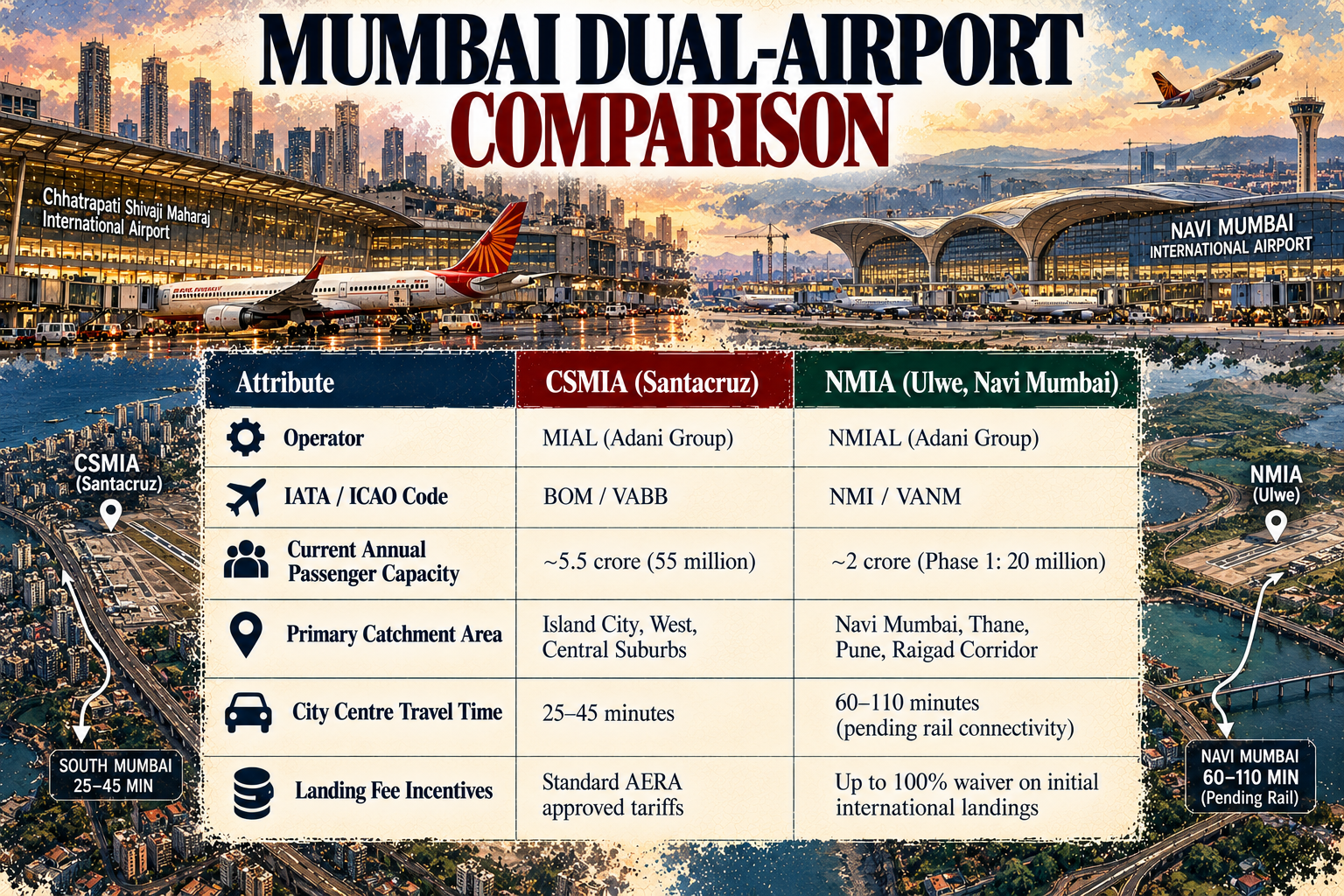
To encourage voluntary migration to Navi Mumbai, AAHL previously offered aggressive commercial incentives, including a 100% discount on landing fees for select new international flights. Yet airlines remained reluctant to move. The underlying reality is that landing fee waivers rarely offset the revenue loss incurred when premium passengers decline to book flights operating out of an airport lacking dedicated rapid mass transit.
While the Maharashtra State Road Transport Corporation (MSRTC) recently introduced dedicated electric express bus services linking CSMIA to NMIA via the Atal Setu, surface buses sharing arterial traffic cannot replicate an integrated airside transfer or a high-speed rail connection.
What Happens Next?
The outcome of the 13 October and 20 October stakeholder summits will set an important precedent for Indian civil aviation governance. Three potential compromises are currently under review by industry analysts and ministry officials:
Selective Domestic Transfer: Rather than evicting international carriers, MIAL could encourage newly added domestic routes or select point-to-point regional low-cost operations (such as flights to non-metro destinations) to launch from NMIA, preserving core international connectivity at T2.
Modular On-Site Terminal Capacity: MIAL could erect temporary, semi-permanent passenger concourses near Terminal 1 or Kalina to handle domestic security processing, containing the displacement within the existing CSMIA footprint.
Phased Winter Schedule Compromise: Deferring major slot reallocations until the Summer Schedule of March 2027, giving airlines the six-month planning window required under global slot allocation standards to adjust booking engines, crew rosters, and bilateral authorizations.
Until independent safety audits and empirical capacity data are laid on the negotiating table, the standoff between Adani Airports and the world's commercial airlines will remain a litmus test for infrastructure planning in India's commercial capital.