In brief
- Global investors are pushing back on Jio Platforms’ IPO price. Bankers wanted a value of $143-146 billion, but investors are talking about $100-114 billion, a cut of up to $60 billion.
- The main reason is Bharti Airtel. Jio was pitched at about 18 times its operating profit, while Airtel trades at 11-12 times. Several funds want Jio about 30% cheaper than Airtel.
- The IPO aims to raise ₹33,000-37,700 crore, which would make it India’s biggest ever, ahead of Hyundai India’s ₹27,870 crore. Up to ₹27,500 crore of that is for paying off debt, not for growth.
- The 2020 investors, like Meta, Google and KKR, are stuck. The rupee fell from about ₹75 to ₹96.7 per dollar, so at a $100 billion value some of them would earn only about 6.6% a year in dollars.
- Elon Musk’s public attack on India’s Starlink licensing rules came at a bad moment. The IPO is expected to open in late October or November 2026, and it could still be delayed to 2027.
Global institutional investors have delivered a firm message to the underwriters of India’s largest proposed initial public offering: Jio Platforms will not be priced as a Silicon Valley software titan when its earnings remain anchored to Indian mobile towers.
During overseas marketing roadshows across New York, London, Singapore, Hong Kong, and Dubai, merchant bankers representing Reliance Industries Limited (RIL) encountered stiff pushback from foreign institutional funds over the company's valuation aspirations. Meetings led by Jio Platforms Managing Director and Reliance Jio Chairman Akash Ambani, alongside Reliance Retail Ventures Director Isha Ambani, were designed to establish an enterprise valuation between $143 billion and $146 billion (roughly ₹12 lakh crore to ₹12.5 lakh crore), following informal whisper numbers earlier in the year that reached as high as $160 billion (Business Standard Report).
Instead, discussions with asset managers have gravitated towards a range of $100 billion to $114 billion (Businessworld Investigation, Bloomberg via Binance). That adjustment represents a contraction of up to $60 billion (approximately ₹5.8 lakh crore at prevailing exchange rates) before the first prospectus order is booked.
The issue, seeking to raise between ₹33,000 crore and ₹37,700 crore ($3.8 billion to $3.9 billion) by issuing up to 27 crore (270 million) fresh equity shares, will comfortably surpass Hyundai Motor India's ₹27,870 crore offering to become the largest IPO in domestic capital market history (Fortune India). Yet the tenor of the roadshow reveals a widening gulf between promoter ambitions and the terms institutional capital is prepared to accept during a broader market correction.
The Airtel Benchmark and the Conglomerate Arbitrage
The crux of the institutional pushback lies in the comparative economics between Jio Platforms and its primary domestic peer, Bharti Airtel Limited.
Underwriters pitched Jio Platforms at an enterprise multiple approaching 18× operating profit (EBITDA), pointing to its digital ecosystem, indigenous 5G standalone architecture, and an expanding suite of enterprise cloud and entertainment services. But institutional portfolio managers evaluating the asset have treated it primarily as a telecommunications utility (Outlook Business).
In the financial year ended 31 March 2026 (FY26), Jio Platforms reported revenue of ₹1,46,885 crore ($15.19 billion) and a net profit of ₹30,049 crore ($3.11 billion), supported by an EBITDA margin of 51.91% and 52.4 crore subscribers (524.4 million subscribers) (Univest Market Analysis, INDmoney Filing Analysis). Despite efforts to cross-sell cloud applications, digital payments, and media streaming, more than four-fifths of top-line cash flows still stem from connectivity.
Bharti Airtel, which maintains a higher Average Revenue Per User (ARPU) profile in its domestic wireless business, trades in the public markets at roughly 11× to 12× one-year forward EV/EBITDA. Fund managers in London and New York have argued that a newly listed company with promoter control, debuting amid volatile emerging-market conditions, ought to trade at a discount to the established, liquid incumbent—not at an enterprise premium. Several funds indicated that an entry multiple roughly 30% below Airtel’s trading levels would be required to build a high-conviction book.
Furthermore, investors presented syndicate bankers with a structural dilemma: if Jio Platforms debuts without an attractive valuation discount, institutions can capture exposure to Jio's underlying cash generation more cost-effectively by purchasing shares of parent Reliance Industries. RIL trades with a conventional conglomerate holding-company discount; buying the parent offers exposure to the same telecom asset alongside retail and energy cash flows at a lower implied multiple.
The 2020 Backers: Trapped by the Rupee
While a lower issue price challenges the pricing prestige of Reliance Industries, the financial burden falls most heavily on the 13 international financial and strategic sponsors who backed Jio Platforms in 2020.
Between April and July 2020, during the height of the COVID-19 pandemic, Mukesh Ambani orchestrated a funding sweep that raised $20.3 billion by divesting roughly 33% of Jio Platforms across 14 transactions. That roster included Meta Platforms and Alphabet's Google, alongside sovereign wealth funds (Saudi Arabia’s PIF, Abu Dhabi’s Mubadala and ADIA) and private equity sponsors (KKR, Silver Lake, Vista Equity Partners, General Atlantic, and TPG).
Meta and Google acquired their stakes at an allotment price of ₹488 per share, while the remaining 11 institutional backers entered at ₹549 per share.
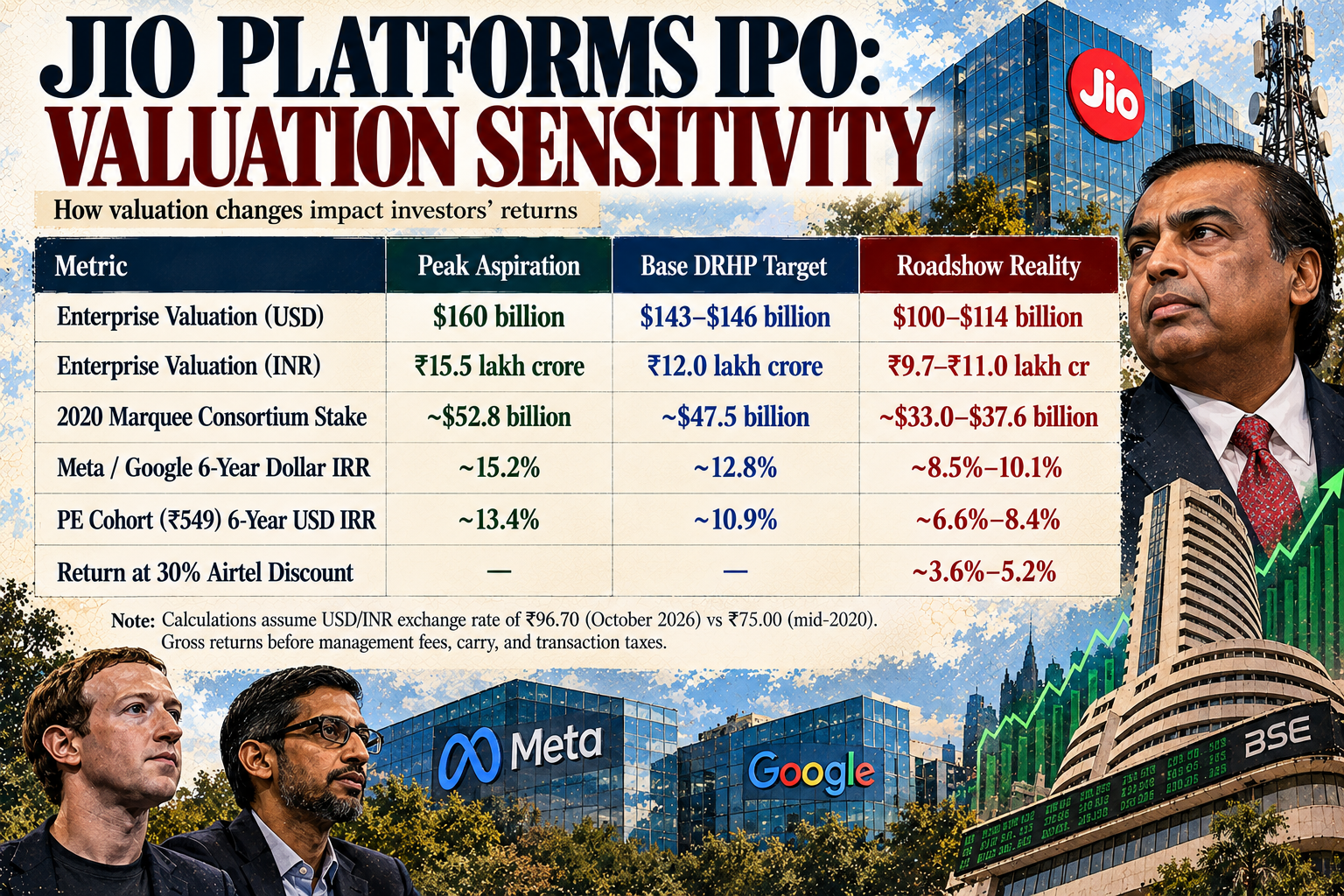
The mathematical trap confronting these funds is exchange-rate depreciation. In mid-2020, the Indian rupee traded near ₹75 against the US dollar. By October 2026, the rupee had weakened to approximately ₹96.7 per dollar—a depreciation of approximately 29%.
That currency shift has stripped roughly $11 billion in dollar gains from the consortium's balance sheet. In domestic currency terms, the private equity sponsors have registered a compound annual growth rate (CAGR) of 14% to 17%. But these funds report performance, pay limited partners, and calculate carried interest in US dollars.
At an enterprise valuation of $120 billion, the consortium’s combined holding is worth approximately $38.4 billion, representing a 1.89× multiple on invested capital, or an annualized dollar return of roughly 10.9% over six years—acceptable, but well beneath historical venture-growth benchmarks.
At a $100 billion valuation, total value for the 2020 cohort contracts to approximately $32 billion. For the private equity sponsors who entered at ₹549 per share, the dollar IRR drops to 6.6%. Should public market pricing require a further discount, their net return drops towards 3.6% per annum—a return profile that trails passive US Treasury yield curves over the identical holding period.
By contrast, Reliance Industries built its original pre-2020 equity base at an effective cost of approximately ₹10 per share. Even at the lower end of roadshow price talk, Reliance’s internal return exceeds 14× its dollar cost, yielding an annualized return close to 49%. Reliance can absorb a lower price tag; its 2020 financial partners cannot do so without booking disappointing fund returns.
The Use of Proceeds: Deleveraging Over Expansion
A close reading of Jio Platforms’ Draft Red Herring Prospectus (DRHP) explains why institutional capital has adopted a defensive posture.
Of the anticipated net issue proceeds—estimated between ₹33,000 crore and ₹37,700 crore—the company has formally earmarked up to ₹27,500 crore ($2.84 billion) for a single objective: prepaying and servicing the outstanding commercial borrowings of its material operating subsidiary, Reliance Jio Infocomm Limited (Fortune India DRHP Details). The remainder is allocated to general corporate requirements.
This allocation clarifies the corporate motivation. The IPO does not fund next-generation artificial intelligence compute clusters, edge data centres, or satellite transponders. It is an exercise designed to de-lever the balance sheet of the capital-intensive telecom arm following years of aggressive 5G standalone network deployment and spectrum auction expenditures.
While debt reduction will immediately strengthen consolidated earnings by trimming recurring finance costs, public market funds rarely award high-growth software valuation multiples to companies using fresh equity primarily to retire debt.
The Regulatory Backdrop and Elon Musk’s Intervention
External complications compounded the roadshow discussions during early October. As Akash Ambani and bank syndicates met with institutional allocators in London and New York, SpaceX Chief Executive Elon Musk published public criticisms on social media platform X, targeting India's telecommunications regulatory framework.
Musk alleged that domestic regulatory hurdles preventing Starlink from securing commercial satellite broadband operating licences in India were designed to protect incumbent operators, referring to "certain oligarchs" maintaining a "monopolistic chokehold on the Indian people." In follow-up remarks, Musk questioned why Starlink remained without an operational licence despite five years of compliance efforts, directly mentioning Reliance Chairman Mukesh Ambani (Businessworld Investigation, Economic Times Coverage).
The controversy centres on satcom spectrum assignment. Reliance Jio has consistently lobbied the Department of Telecommunications and the Telecom Regulatory Authority of India (TRAI) to auction satellite communication frequencies through open competitive bidding, arguing this ensures a level playing field with terrestrial telcos that purchased spectrum at auction. Starlink, in alignment with global satellite industry standards, has argued for administrative allocation.
While Indian political and regulatory authorities reiterated that national security clearances and licensing norms apply uniformly to all foreign satcom applicants, the public exchange emerged at an awkward moment for Jio's marketing teams. For overseas allocators, the incident renewed scrutiny over how much of Jio’s domestic dominance reflects operational execution versus statutory moats, and whether long-term telecom tariff pricing power will remain resilient if low-Earth-orbit satellite networks eventually secure commercial entry.
Strategic Options Facing Syndicate Bankers
With regulatory approval from the Securities and Exchange Board of India (SEBI) secured, the transaction syndicate faces three practical choices ahead of an expected opening in late October or November 2026:
Accept the Valuation Haircut ($100bn–$114bn): Price the offering to clear institutional demand by offering the 25% to 30% discount against Bharti Airtel demanded by global asset managers. This ensures a fully subscribed, liquid debut that avoids post-listing embarrassment, but locks in sub-optimal returns for the 2020 private equity partners.
Hold the DRHP Price Floor ($140bn+): Insist on an enterprise value north of ₹12 lakh crore, leaning heavily on domestic institutional investors (DIIs), mutual funds, retail quotas, and supportive sovereign accounts. This path preserves the headline valuation narrative but risks an unenthusiastic international book and potential listing-day price fatigue.
Delay the Timetable: Postpone the listing window into early 2027 to await a stabilising domestic equity market and potential post-election macroeconomic clarity. However, deferral would carry reputational costs for Reliance after public announcements at its Annual General Meeting promising a timely listing.
As bookrunners finalise the red herring prospectus and price band, the roadshow feedback has reset expectations. Jio Platforms remains a market leader in subscriber scale and digital infrastructure. But as its equity enters the open market, institutional investors are pricing the company on its capital intensity, debt load, and cash flow realities rather than conglomerate aspirations.