In brief
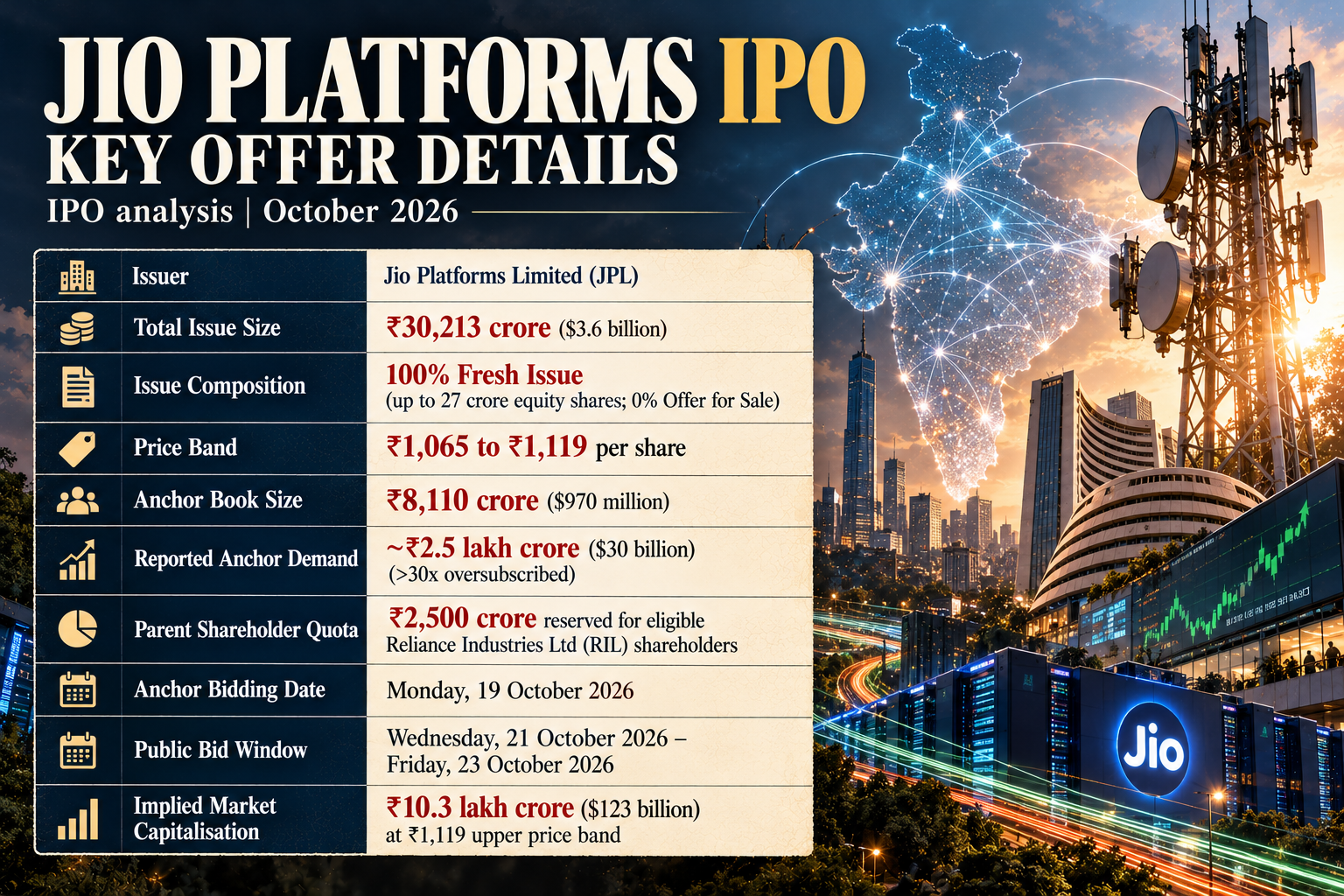
- Institutional investors bid approximately ₹2.5 lakh crore for the ₹8,110 crore anchor book of Jio Platforms Limited, oversubscribing the allocation by more than 30 times.
- The anchor placement precedes the public opening of Jio Platforms' ₹30,213 crore initial public offering, which runs from 21 October to 23 October 2026 at ₹1,065 to ₹1,119 per share.
- At the upper price boundary, Jio Platforms commands an implied equity valuation of ₹10.3 lakh crore, making it the largest public market debut in Indian financial history.
- The net proceeds from the 27 crore newly issued shares are designated primarily to prepay or repay outstanding borrowings incurred by Reliance Jio Infocomm Limited, with general corporate purposes also mentioned.
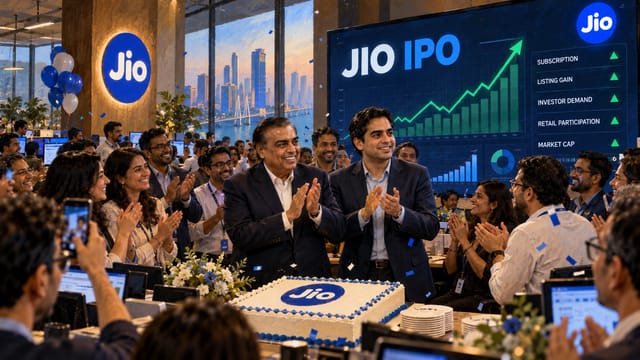
On Monday, 19 October 2026, institutional investors submitted approximately ₹2.5 lakh crore ($30 billion) in bids for the ₹8,110 crore ($970 million) anchor book of Jio Platforms Limited, oversubscribing the available allocation by more than 30 times.
The sheer volume of capital deployed by global sovereign wealth managers, international asset managers, and domestic mutual funds sets a fresh high-water mark for the Indian primary market. The anchor placement precedes the public opening of Jio Platforms' ₹30,213 crore ($3.6 billion) initial public offering (IPO), which runs from Wednesday, 21 October to Friday, 23 October 2026, priced in a band of ₹1,065 to ₹1,119 per share.
At the upper price boundary, Jio Platforms commands an implied equity valuation of ₹10.3 lakh crore (about $123 billion), confirming its position as the largest public market debut in Indian financial history.
Marquee Institutional Roster
The anchor book saw broad-based participation across sovereign wealth institutions, global long-only funds, domestic mutual fund houses, and state-backed insurers:
Sovereign Wealth & State Pension Funds: Singapore’s GIC Pte Ltd, the Abu Dhabi Investment Authority (ADIA), Norway’s Norges Bank Investment Management, the Qatar Investment Authority (QIA), and Mubadala Investment Company.
Global Asset Managers: BlackRock, Capital Group, Fidelity Investments, T. Rowe Price, Schroders, JPMorgan Asset Management, Franklin Templeton, Invesco, and Janus Henderson.
Domestic Mutual Funds: SBI Mutual Fund, ICICI Prudential Mutual Fund, HDFC Mutual Fund, Nippon India Mutual Fund, Aditya Birla Sun Life Mutual Fund, and Kotak Mahindra Asset Management Company.
Insurers & Pension Managers: Life Insurance Corporation of India (LIC), HDFC Life Insurance, SBI Life Insurance, SBI Pension Funds, and HDFC Pension.
Under Securities and Exchange Board of India (SEBI) guidelines, 50% of the shares allocated to anchor investors are locked in for 30 days post-allotment, with the remaining 50% subject to a 90-day lock-in period. This lock-in ensures that short-term speculative selling is constrained during the stock's immediate secondary trading window.
Capital Allocation: Retiring Telecom Debt
Unlike several large listings that served as partial liquidity mechanisms for existing promoters or private equity funds, Jio Platforms' issue consists entirely of fresh capital.
The net proceeds from the 27 crore newly issued shares are designated primarily to prepay or repay outstanding borrowings incurred by its operating subsidiary, Reliance Jio Infocomm Limited (RJIL), alongside general corporate purposes.
This capital structure decision is operationally significant. Over the past decade, Reliance invested over ₹3 lakh crore into rolling out pan-Indian 4G and 5G network infrastructure. With nationwide 5G standalone (SA) deployments largely complete by late 2025, network capital expenditure has begun tapering. Applying ₹30,213 crore directly towards subsidiary debt reduction accelerates free cash flow generation and lowers interest costs, strengthening JPL's consolidated balance sheet where net leverage had already contracted to 0.36 times at the end of FY26.
Operational and Financial Scale
Jio Platforms operates as the holding company for Reliance Industries' connectivity, cloud, broadband, and consumer digital assets. Financial disclosures from recent brokerage reviews highlight a marked operational transformation over the past three fiscal years:
Subscriber Base: Reliance Jio Infocomm served 53.3 crore subscribers (533.3 million users) as of June 2026. Within this base, 5G users reached 28.5 crore (285 million), reflecting accelerated migration from legacy 4G tariffs.
ARPU Expansion: Average revenue per user (ARPU) expanded from ₹181.7 in FY24 to ₹215.6 in Q1 FY27, assisted by industry-wide tariff revisions and higher bundled data consumption.
Revenue Trajectory: Consolidated revenue from operations increased from ₹1,09,558 crore in FY24 to ₹1,46,885 crore in FY26.
Operating Profitability: Earnings before interest, tax, depreciation, and amortisation (EBITDA) reached ₹76,255 crore in FY26 (an EBITDA margin of 51.9%), up from ₹54,959 crore in FY24.
Net Profit: Profit after tax (PAT) rose from ₹21,423 crore in FY24 to ₹30,049 crore in FY26, yielding a net margin of 20.4%.
Intellectual Property: As of June 2026, the company held 7,220 patent applications filed across 5G standalone architecture, 6G development, cloud-native core systems, and artificial intelligence network automation.
Valuation Benchmarks: How Jio Compares
At ₹1,119 per share, Jio Platforms is valued at approximately 33.3 to 34 times FY26 earnings and roughly 15 times EV/EBITDA, according to IPO notes issued by Mirae Asset Sharekhan and Religare Broking.
During initial roadshows, global institutional investors debated whether Jio Platforms should trade at a persistent valuation premium over its domestic competitor, Bharti Airtel. Sceptics pointed out that despite ambitions in enterprise cloud, fixed wireless access (JioAirFiber), and consumer software, telecom access tariffs still account for the dominant majority of consolidated top-line revenue.
Supporting analysts argue, however, that Jio’s capital return profile differs from traditional telcos. With 53.3 crore subscribers, an easing capital expenditure run-rate, and rapid home broadband uptake, the company's operating leverage is expanding. The prepayment of RJIL debt directly enhances equity returns, justifying a premium multiple relative to pure-play regional carriers.
Generational Continuity: 1977 to 2026
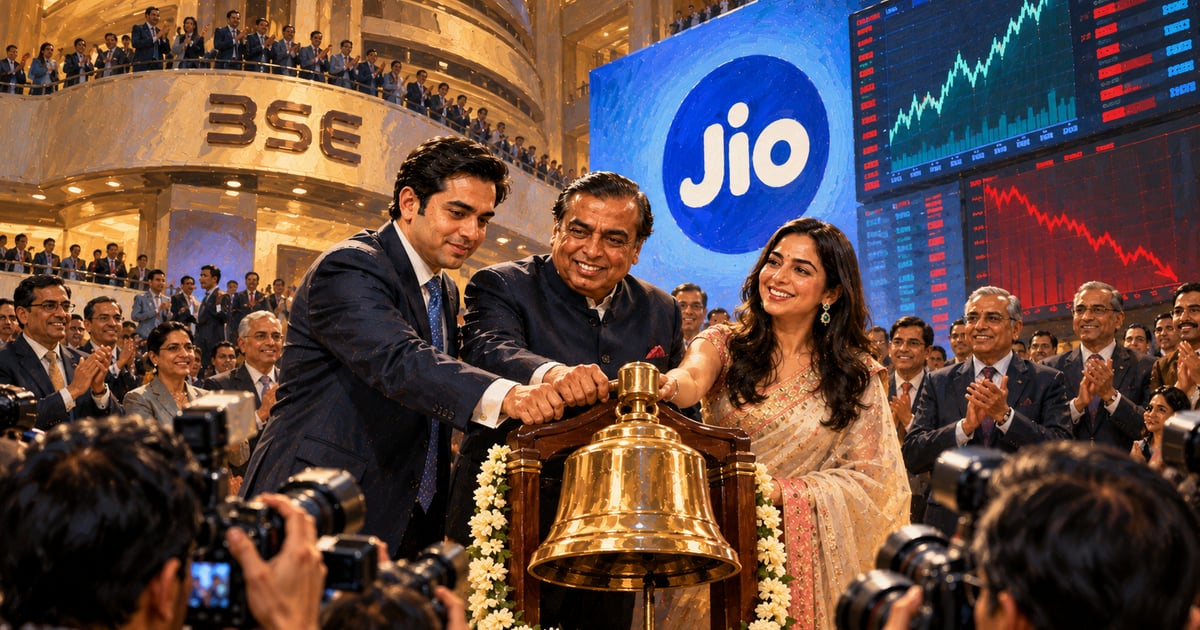
The offering is also Akash Ambani's first major corporate transaction conducted as managing director of Reliance Jio Infocomm, representing a symbolic passing of the baton in the Ambani corporate narrative.
Almost 49 years earlier, in November 1977, Reliance Industries founder Dhirubhai Ambani launched the group's foundational public offering, raising ₹2.8 crore ($3.4 million) from approximately 58,000 retail investors. That issue was subscribed seven times, initiating the modern retail equity culture in India and culminating in shareholder annual general meetings held inside Mumbai football grounds.
Today, India's equity market includes more than 13 crore registered demat accounts (130 million accounts), with over 40% held by investors under the age of 30. The reception of Jio Platforms across retail and high-net-worth individual (HNI) categories over the coming three days will test whether that domestic retail investor base displays the same appetite for Reliance's digital arm as global institutional sovereigns demonstrated in Monday's anchor book.